
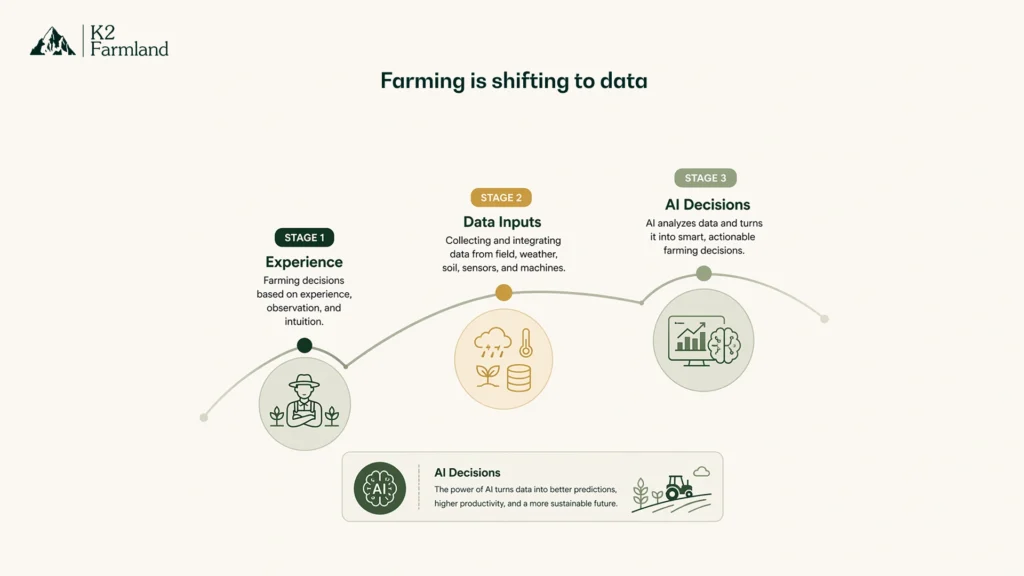
Farming decisions are influenced by experience, intuition, and several unpredictable factors. This is not the story of a year but more than a decade. But speculation is not viable in a world where margins are decreasing, and input costs are significantly increasing.
Nowadays, artificial intelligence is actively used in farm operations as a practical tool to enhance decision-making. From forecasting crop yield to optimizing inputs and improving farm profitability, AI is changing agriculture at its core. According to NITI Aayog, AI in agriculture is expected to add $500 billion to India’s GDP by 2035 through increased yields and reduced losses.
Despite the benefits, AI adoption in the agriculture sector remains uneven. This gap is not about just technology but about how technology is delivered. Platforms like K2 Farmland fill the gap between advanced AI capabilities and real-world farm operations.
This article explores how AI in farming is actually being used today, where it delivers real value, and how product-driven technology solutions are making it accessible.
Why Farm Operations Need Predictive Intelligence?
Predictive intelligence in agriculture analyzes real-time and historical agricultural data using algorithms, machine learning models, and data mining techniques. Predictive intelligence aims to forecast future outcomes, such as crop production, pest swarms, weather, and market trends, with higher accuracy. By using data from sources such as satellite imagery, IoT sensors, and historical farm records, this predictive intelligence helps farmers make informed decisions. The benefits of predictive intelligence are as follows:
- Optimized Resource Utilization
By examining soil data and weather patterns, predictive intelligence helps farmers determine how to improve water-use efficiency, fertilizer, and pesticide requirements. This not only decreases costs but also reduces environmental impact.
- Improved Crop Production
Predictive intelligence can predict optimal planting and harvesting times, ensuring crops are grown under favorable conditions and boosting durable yields.
- Weather Prediction
Organizations like The Weather Company at IBM offer hyper-local weather predictions that help farmers plan their activities.
- Pest Control and Disease Management
This approach discovers patterns indicative of pest infestations or disease outbreaks. For example, a tea plantation in India used predictive intelligence to lessen pest-related losses.
- Yield Prediction
Various startups, such as CropX, use soil and crop data to forecast yields with higher accuracy. This helps farmers to plan their finances and operations efficiently.
- Market Price Forecasting
Predictive intelligence can forecast market prices for crops, allowing farmers to decide when to sell for maximum profit.
What is AI In Farming Today?
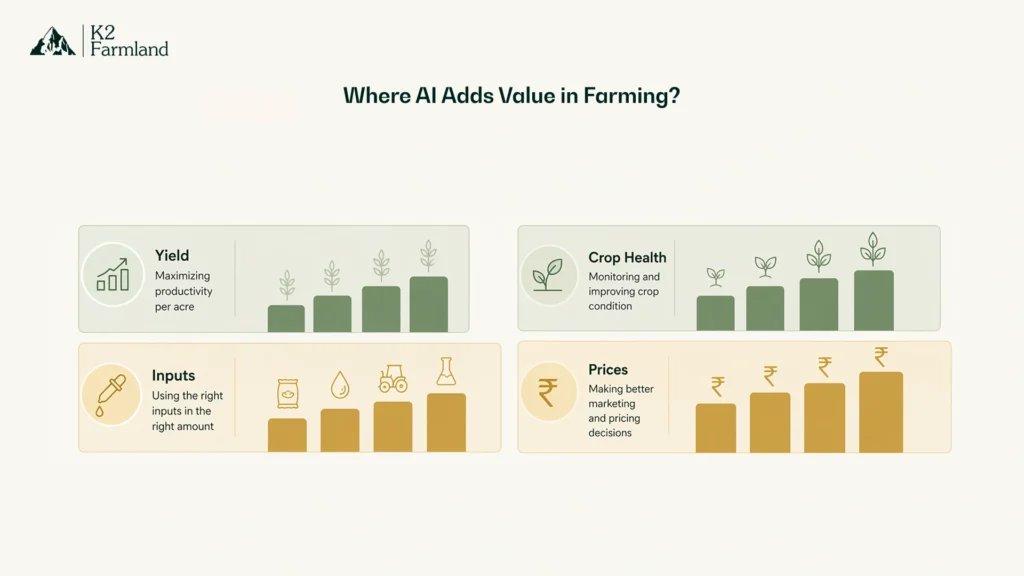
From weather prediction to increased agricultural productivity and simple resource management, AI has a huge impact on agriculture. Now you are thinking, how AI is applied to farming. The applications are as follows:
- Soil, Crop, and Fields Analysis
The future of agriculture depends on soil. By examining the satellite imagery, AI can evaluate the soil health. This includes analyzing moisture and nutritional value, as well as identifying areas that need modification.
Also, it enables the exact use of fertilizers and pesticides by thorough analysis of crop and soil data. By preventing over-application, which can harm soil health, AI adopts a strategy that reduces costs, environmental damage, and encourages healthy crop growth.
- Monitoring Livestock
AI is helping to change livestock management by improving overall productivity, welfare, and animal health. It includes several tools for tracking, identifying, and predicting animal health problems. The application of AI also includes monitoring the temperature, heart rate, and activity levels by using sensors on animals. By incorporating AI into the milking process, the dairy industry can increase milk production efficiency and detect any health issues that may be affecting milk output.
- Identify Plant Illness
Satellite imagery can detect plant disease, crop growth, and soil quality. In agriculture, AI is used to scan photos for insects and other crop health issues. It enables farmers to take corrective actions to reduce pests or prevent the spread of illness.
- Yield Mapping
Yield mapping analyzes large datasets in real time using machine learning methods, and it is a common feature of AI in agriculture. It improves planning by helping farmers understand crop trends and traits. Using methods such as 3D mapping, sensor data, and drone data, farmers can predict soil yields for certain crops.
Introduction of various gadgets that monitor crop health, examine soil conditions, and monitor livestock to ensure they produce milk and even harvest goods on their own. AI in farming enables farmers to make strategic decisions that increase efficiency and sustainability.
AI For Yield Forecasting
AI-based yield forecasting is no longer a fancy activity. The working of AI in yield forecasting is as follows:
- Satellite-based Crop Monitoring Platform
These platforms offer the raw and multispectral data, which become the foundation of AI models. The high-resolution imagery and vegetation indices provide continuous, real-time examination of crop health and growth status.
- Climate and Weather Intelligence
The sophisticated machine learning models integrate historical and real-time climate data to support crop prediction and weather forecasting. It enables accurate weather-driven productivity forecasting by highlighting the effects of heat stress or drought. Using the previous data, real-time information, and future prediction models, predict weather data with higher accuracy.
- Remote Sensing
It becomes the super-scanner for the fields. Specialized algorithms examine high-frequency drone and in-field camera imagery to witness what the human eye cannot see. It extracts key parameters, including plan density, canopy size, and early disease markers. This strong crop health data for yield forecasting provides detailed sub-field-level insights, enabling intervention at the row level.
- Predictive Crop Growth Modeling
These are advanced engines that drive plant growth under several conditions. Developed upon machine learning foundations, these AI yield forecasting platforms run various scenarios to generate predictive yield outcomes. This model predicts crop growth progression from sowing. It provides an indication of crop health and progression towards maturity, and it predicts harvest dates.
It offers an important prediction of a transformative shift from descriptive analysis to extremely accurate, predictive yield analysis.
Optimizing Inputs Using AI
AI is revolutionizing agriculture by transforming traditional, labor-intensive farming into data-driven, precision-based operations. The key areas of AI input optimization include:
- Precise fertilizer application
AI algorithms analyze data from IoT soil sensors, including pH, nitrogen, and phosphorus measurements, to suggest precise site-specific applications.
- Smart irrigation
It combines real-time soil moisture sensor data with weather predictions to determine the precise amount of water requirement, reducing over-irrigation.
- Precise pesticide use
AI-powered computer vision detects weeds and pests and enables targeted application of pesticides, reducing chemical use.
- Livestock monitoring
AI-powered cameras and behavior analytics enable remote monitoring, helping detect diseases and behavioral changes in livestock to optimize care.
It aims to increase production and reduce resource wastage simultaneously.
Challenges in AI Adoption
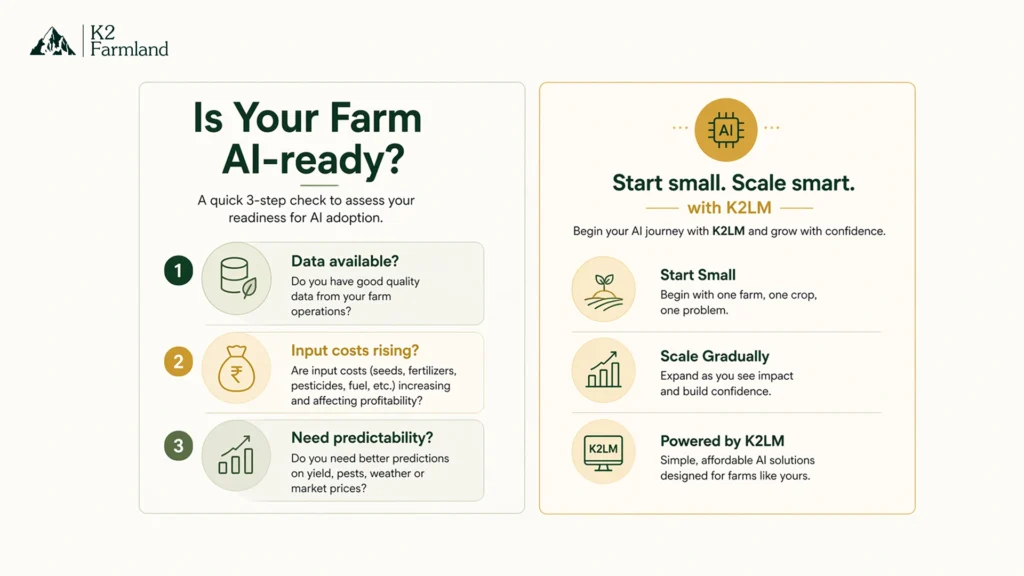
While the introduction of AI and predictive intelligence in agriculture holds huge potential, it also poses certain challenges.
- Data Quality Challenges
Incomplete or incorrect data can lead to inaccurate predictions. For instance, outdated soil data may lead to incorrect fertilizer recommendations.
- Higher Initial Costs
The use of predictive intelligence requires investment in sensors, software, and training, which can be costly for small-scale farmers.
- Complexity of Models
Machine learning models can be difficult to explain, making it challenging for farmers to trust the recommendations.
- Infrastructure Restrictions
In developing nations, the shortage of internet connectivity and electricity can prohibit the implementation of predictive intelligence.
- Mental Barrier
Traditional farmers may be unsure about adopting new technologies; therefore, they prefer to rely on their assumptions and intuition.
Future Of AI In Farm Operations
AI will play an important role in farm operations and food sustainability over the next 10 years. Technology has always been at the forefront of agriculture, from primitive tools to irrigation to tractors to AI. Each development has enhanced the efficiency while reducing the farming challenges.
The advantages of AI in agriculture are undeniable. Several smart farming tools, intelligent automation,, and AI-powered products automate repetitive, time-consuming tasks, so workers can focus on strategic operations that require human judgment.
AI also addresses the challenges posed by climate change, environmental hazards, and the higher demand for food. It will be a revolution in modern agriculture by enhancing efficiency, sustainability,, and resource allocation for higher-quality production.
Lastly, AI will change farmers’ roles from manual labor to planning and overseeing smart agricultural systems. IT solutions and agribusiness intelligence will become more valuable than traditional tools.
How Can K2 Farmland’s Product + Tech Help?
The product and technology platforms like K2 Farmland are the central point for AI in agriculture. The key roles of these platforms include:
- Track SOC levels to provide long-term fertility and increase soil organic carbon. This supports sustainable crop cycles and strengthens soil resilience against climate stress.
- Improves water use efficiency through precise irrigation and rainwater harvesting. Smart sensors and predictive analytics help reduce wastage and improve yield consistency.
- The multi-crop systems increase biodiversity and create healthy ecosystems. This approach balances nutrient cycles and naturally reduces pest outbreaks.
It converts fragmented data from satellite imagery, drones, and sensors into real-time insights.
FAQs
What is the accuracy of AI-based yield forecasting?
Accuracy depends on data quality and model sophistication, but it is generally more reliable than traditional estimation methods.
Can small farmers use AI in farming?
Yes, through various service-based models and shared platforms, AI tools are becoming more accessible.
Does AI reduce farming costs?
Yes, especially by optimizing input usage and reducing labor dependency.
Is AI replacing farmers?
No, it is designed to support farmers by improving productivity and efficiency.
Conclusion
AI is an important concept in agriculture. It is reshaping farm operations, especially by predicting yields, optimizing inputs, and improving profitability. AI helps minimize uncertainty and promote consistency at the farm level, from crop monitoring by drones to predictive intelligence.
With K2 Farmland, AI goes beyond theory and becomes a trustworthy tool that helps farmers make sound decisions, reduce risk, and build more resilient operations.
Key Takeaways:
- AI in agriculture improves predictive insights, allowing farmers to access data.
- Crop-based forecasting helps reduce uncertainty and manage risk, enabling better planning for harvesting and market timing.
- Input optimization directly reduces costs and enhances productivity by allowing more accurate use of water, fertilizers, and pesticides.
- Farm profitability improves when data connects inputs and outputs, creating a clear picture of what increases returns.
- Product + tech platforms make AI practical and scalable. It converts complex analytics into simple, actionable decisions.