
Agriculture is no longer limited to the old tractors, rainfall, and seasonal aspects. Farms now operate in a more data-rich environment. Powered by sensors, automation, AI-driven forecasting, and real-time monitoring systems. This era is called Agriculture 4.0.
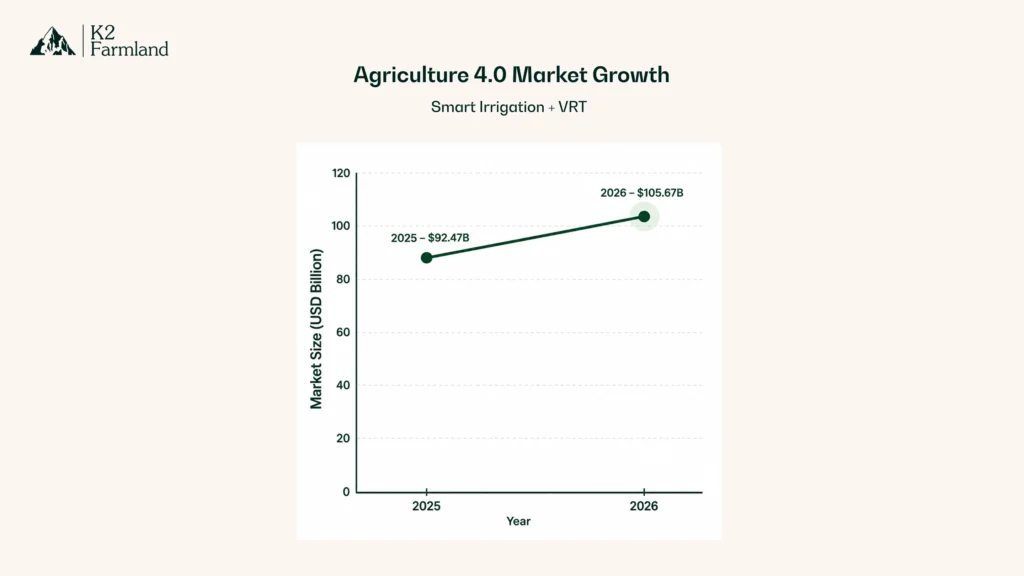
Now, for investors, this shift matters more than ever. The global investment in agriculture has grown at an average annual rate of 8.1% in recent years.
Now the focus should be on “How efficiently is the land performing?” instead of “How many acres of land are under cultivation?” The investments are now evaluated based on measurable operational performance, sustainability metrics, crop intelligence, supply chain visibility, and other factors.
Thus, the growth of digital farming becomes even more evident. At K2 Farmland, the focus is not just on growing your farmland. Here, the priority is to build operationally strong, future-ready agricultural systems that will generate long-term value.
Let’s understand what Agriculture 4.0 actually means and how it shapes the future investment landscape for people.
Why Investors Are Paying Attention to Digital Farming?
Digital farming introduces an advanced approach that integrates operational intelligence.
Investors are now looking at their agricultural lands through a completely different lens:
- Can technology improve yield predictability?
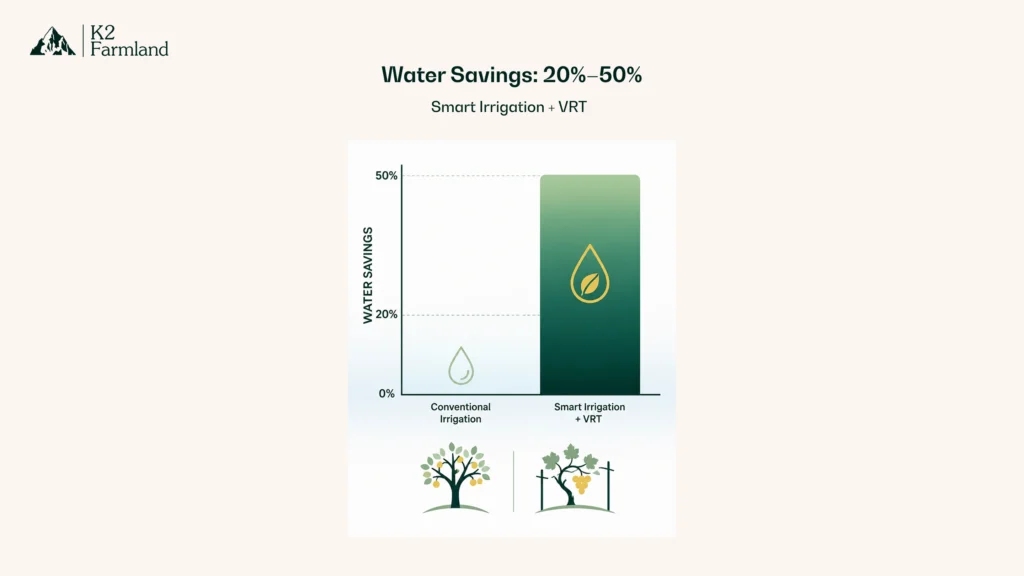
- Can farms reduce water consumption?
- Can operational costs become more efficient?
- Can crop risks be identified earlier?
- Can supply chains become more transparent?
- Can farmland become more climate-resilient?
The answer increasingly appears to be yes.
This market is growing rapidly due to the rising adoption of AI, IoT, precision farming systems, and other automation technologies. This can be exceptionally beneficial for investors managing different farmland investment models in which operational performance directly impacts overall returns.
What Digital Farms Actually Measure?
One of the biggest misconceptions about digital farming is that it only involves drones or automated irrigation systems. In reality, the core value comes from measurement. Digital farms constantly gather operational data that helps improve decision-making.
Here are some of the most common areas modern digital farms measure:
- Soil Health
Sensors can monitor:
- Soil moisture levels
- Nutrient density
- pH balance
- Organic matter content
- Temperature variations
This helps operators optimize irrigation and fertilizer application instead of relying on blanket usage patterns.
- Water Efficiency
Water is becoming one of agriculture’s biggest risk factors.
Digital systems can track:
- Irrigation timing
- Water usage per acre
- Leak detection
- Evaporation patterns
- Water stress in crops
This improves sustainability while reducing operational waste.
- Crop Health Monitoring
Satellite imaging, drones, and AI-driven analytics help detect:
- Pest outbreaks
- Crop diseases
- Nutrient deficiencies
- Growth irregularities
- Heat stress
Early detection allows farms to act before problems spread across large areas.
- Weather And Climate Data
Digital farms continuously analyze:
- Rainfall forecasts
- Temperature fluctuations
- Humidity levels
- Wind conditions
- Frost probability
This supports better crop planning and operational timing.
- Yield Forecasting
Modern systems can estimate expected production levels based on historical performance and real-time field data. This helps investors and operators improve revenue forecasting and supply planning.
The Most Important Farm KPIs Investors Should Understand
Instead of juggling multiple metrics, it is important to focus only on the most useful farm KPIs. These are directly linked to your operational quality, efficiency, and long-term resilience.
- Yield Per Acre
This remains one of the most important agricultural performance indicators.
However, Agriculture 4.0 goes deeper than simple yield numbers. Investors now evaluate:
- Yield consistency
- Yield predictability
- Yield efficiency relative to inputs
- Performance across seasonal cycles
A farm producing slightly lower yields with better operational stability may actually be a stronger long-term investment.
- Water Use Efficiency
This KPI measures the conversion of water into agricultural output. There are many regions currently facing water scarcity. In such cases, irrigation systems through advanced digital farming technologies will actually become a major competitive advantage.
- Input Cost Optimization
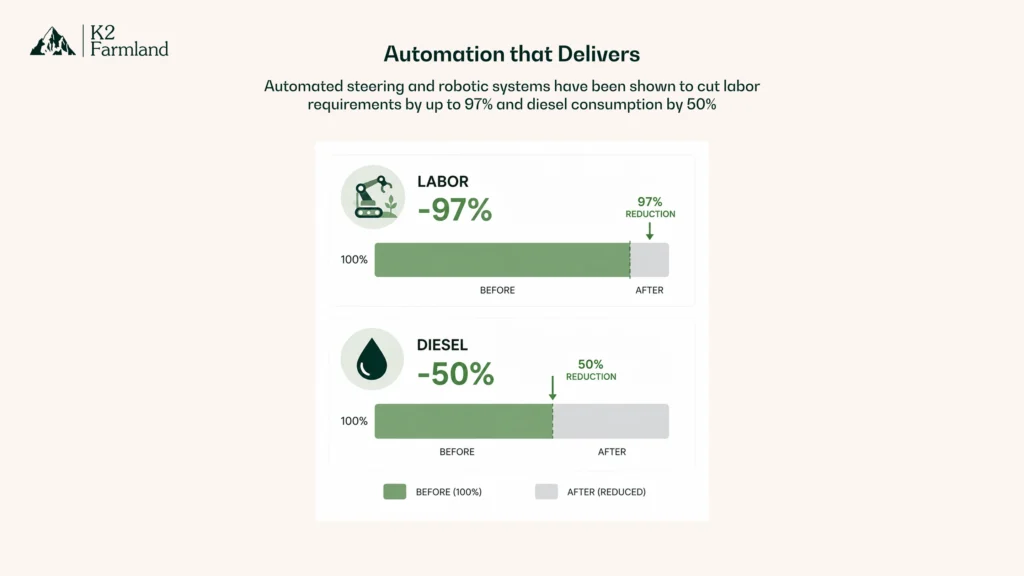
Fertilizers, pesticides, fuel, labor, and irrigation directly impact your investment profitability. Agriculture 4.0 systems help operators reduce unnecessary input use by applying resources only when and where required. This enhances your overall margins and sustainability outcomes in the long run.
- Crop Loss Reduction
Unexpected crop losses can significantly affect investment performance. Digital monitoring systems help identify issues earlier, reducing the likelihood of large-scale losses caused by pests, diseases, or irrigation failures.
- Soil Regeneration Metrics
Healthy soil is a long-term asset.
More investors are now tracking:
- Organic carbon levels
- Soil biodiversity
- Nutrient retention
- Erosion prevention
These indicators influence long-term land productivity and climate resilience.
- Supply Chain Traceability
Modern agricultural buyers increasingly demand traceable sourcing. Digital systems can help track crops from farm to distribution, improving transparency and market positioning.
- Operational Downtime
Equipment failures and irrigation disruptions can create serious inefficiencies. Smart monitoring systems help reduce downtime by identifying maintenance issues early.
How Digital Farming Reduces Agricultural Risk?
Agriculture will always involve some level of uncertainty. Weather patterns, commodity pricing, labor shortages, and biological variables remain difficult to control completely.
However, Agriculture 4.0 significantly improves visibility and response speed. Instead of reacting after damage occurs, digital farms can detect warning signs earlier.
For example:
- Irrigation failures can trigger instant alerts.
- Pest activity can be detected before spreading.
- Weather forecasting tools can improve harvest planning.
- AI models can identify abnormal crop behavior.
This operational intelligence helps farms become more resilient during volatile periods.
For investors, better operational resilience often translates into more stable long-term asset performance.
Why Data Transparency Matters in Farmland Investments?
One of the traditional challenges in agricultural investing has been limited visibility. Investors often depended on periodic reports without real-time operational understanding. Digital farming changes that.
With connected systems, investors can gain clearer insights into:
- Farm productivity
- Water management
- Crop cycles
- Resource efficiency
- Sustainability benchmarks
- Operational performance trends
This creates stronger accountability. Operator-led investment platforms are increasingly using digital reporting systems to improve investor confidence and operational transparency.
At K2 Farmland, the emphasis on disciplined farmland operations aligns closely with this shift toward measurable agricultural performance and long-term stewardship.
K2 Farmland’s Investment Approach
Unlike traditional models, K2 Farmland is an operator-led farmland investment platform. They focus more on long-term agricultural value creation by integrating advanced technologies to better manage agricultural assets.
Their approach mostly centers around:
- Institutional-grade farmland sourcing and due diligence processes to identify the best agricultural assets that are bound to bring long-term growth, suitable climate conditions, and overall better, scalable farming opportunities.
- Regenerative farming systems prioritize aspects like soil health, water conservation, biodiversity, and sustainable agricultural practices. This is aimed at supporting long-term land productivity.
- Diversified crop planning strategies aim to improve operational resilience, reduce dependency on a single crop cycle, and bring more stable agricultural output across various market conditions.
- Experienced on-ground agricultural management teams that oversee all the day-to-day farm operations, monitor farm performance, and ensure that every farming practice aligns with your investment’s long-term productivity goals.
- Structured reporting and measurable farm performance tracking systems to provide greater visibility and help investors better understand how agricultural assets are actually performing over time.
We focus more on environmental resilience and sustainable land management than on anything else. They focus on improving the operational efficiency, ecological restoration, and long-term productivity of your investment. This can be extremely beneficial for modern agricultural investments.
FAQs
What is agriculture 4.0 in simple terms?
Agriculture 4.0 refers to the strategic use of digital technologies such as different kinds of sensors, AI, IoT devices, automation, and analytics for greater efficiency and streamlined farming workflow.
What is digital farming?
Digital farming is the practice of using data-driven technologies to monitor, manage, and optimize various agricultural operations in real time.
Why are farm KPIs important for investors?
Farm KPIs actually help investors evaluate operational efficiency, sustainability, productivity, and risk management capabilities in real time.
What are the most important farm KPIs?
Some of the most important farm KPIs include yield per acre, water efficiency, soil health, crop loss rates, operational cost optimization, and more.
Does agriculture 4.0 improve sustainability?
Yes, Agriculture 4.0 technologies reduce waste, improve resource efficiency, optimize irrigation, and support long-term soil health.
Is agriculture 4.0 only for large farms?
No. Many digital farming technologies are now easily accessible for smaller and mid-sized farms as well.
Why are investors interested in digital farming?
Digital farming enhances the overall operational visibility, reduces potential inefficiencies, and supports long-term sustainability and farm resilience.
Conclusion
Agriculture 4.0 is a massive shift in how people evaluate farmland opportunities. Now the shift is towards measurable operational performance, data transparency, sustainability, and other such critical factors.
The best digital farming technologies from K2 Farmland bring a more efficient, adaptive, and accountable system. Investors can understand the farm KPIs more interactively.
As the agricultural industry continues to grow, farms that combine this operational expertise with intelligent data systems will be better positioned for long-term growth.
Key Takeaways:
- Agriculture 4.0 transforms your traditional farming approach from intuition-based to data-driven. Such greater visibility of operational insights directly improves efficiency and decision-making.
- Digital farming technologies are ideal for measuring critical aspects such as soil health, water use, and climate conditions. These metrics help to avoid potential losses.
- Farm KPIs such as yield consistency, soil regeneration, and others are extremely crucial. Analyzing them will give a clearer picture of your long-term returns.
- Sustainability and profitability are directly interconnected in modern agriculture. The goal is to manage resources with the right technologies.
- Technology alone doesn’t really guarantee success here. Strong execution, experienced operators, and strategic farm management are equally important.