
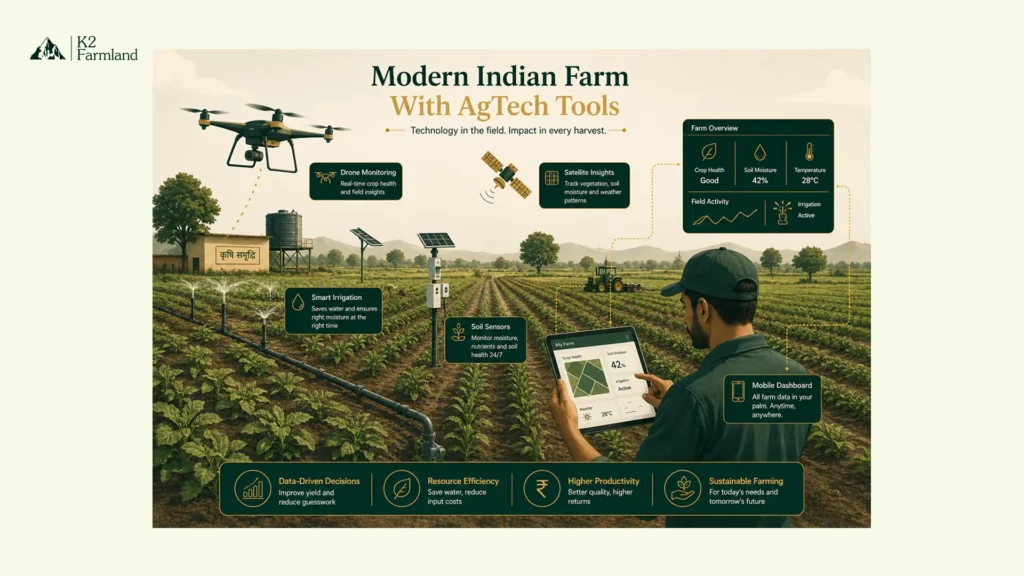
For years, many modern farming tools felt like they belonged to international conferences, not Indian fields. Drones, soil sensors, AI-based crop monitoring, automated irrigation, satellite mapping, and precision tools were often seen as expensive, complex, or simply unavailable for everyday farm operations.
That perception is changing quickly.
Agtech in India is moving from promise to practical use. The shift is not only about new gadgets. It is about better data, stronger digital infrastructure, service-based access, local startups, and farm operators who can convert technology into measurable performance. For farmers, landowners, and farmland investors, this matters because the real value of technology is not novelty. It is better yield stability, lower input waste, stronger soil health, smarter water use, and more predictable farm outcomes.
At K2 Land Management, this is also where modern farmland stewardship begins. K2’s model is built around active, operator-led management, where underperforming land is improved through regenerative design, ag-tech monitoring, water efficiency, diversified systems, and transparent reporting.
Why Farm Technology Once Felt Out Of Reach In India
The idea that advanced farm technology was “not available in India” did not come from nowhere. For a long time, many tools were built for large, uniform farms in developed markets. Indian agriculture, by contrast, is highly diverse, fragmented, and deeply dependent on local soil, water, climate, labor, and market conditions.
Small and marginal farmers dominate Indian agriculture, which means any technology has to work across smaller plots, varied crops, and tight operating budgets. Earlier, many tools also required reliable connectivity, trained operators, substantial upfront capital, and after-sales support, which was not always available in rural regions.
This created a gap between technology and adoption. The tools existed somewhere, but they were not always accessible, affordable, localized, or useful enough for Indian farm realities.
That gap is now narrowing.
What Is Changing In AgTech In India
The first major change is the rise of digital agriculture infrastructure. India’s Digital Agriculture Mission, approved in September 2024, is designed to create a digital public infrastructure for agriculture through AgriStack, Krishi Decision Support System, and soil fertility mapping. The aim is to make reliable crop and farm information available in time for farmer-centric digital solutions.
AgriStack includes foundational databases such as geo-referenced village maps, crop sown registry, and farmers registry. These systems can help improve access to services such as credit, insurance, procurement, inputs, and digital marketplaces.
The second change is the growth of India’s agtech ecosystem. McKinsey notes that India’s agtech landscape grew from fewer than 50 startups in 2013 to more than 1,000 by 2020, supported by rising farmer awareness, rural internet penetration, and the need for agricultural efficiency.
The third change is that agritech is no longer only about selling software. It now includes input platforms, advisory apps, drone services, satellite monitoring, farm management systems, mechanization-as-a-service, quality grading, supply chain tools, credit, insurance, and precision farming. EY’s agritech report identifies opportunities across input linkages, precision agriculture, farm management, quality and traceability, post-harvest supply chains, and financial services.
In simple terms, agtech in India is becoming less like a luxury product and more like an operating layer for farming.
Why Farm Automation Is Becoming More Practical
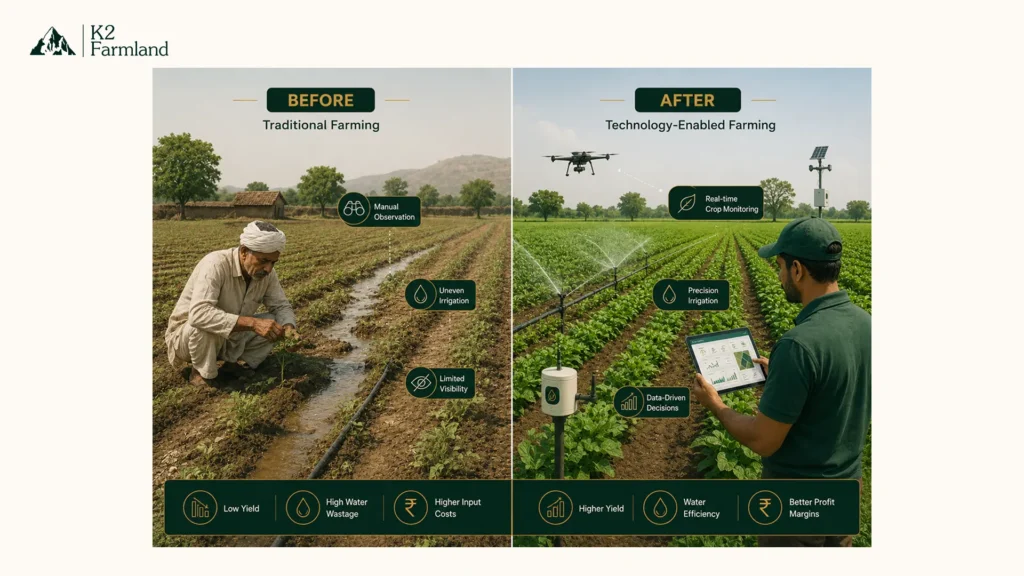
When many people hear farm automation, they imagine fully driverless tractors or robotic harvesters. Those tools may come over time, but the more immediate opportunity in India is practical automation.
This includes automated irrigation scheduling, remote pump control, drone-based spraying, sensor-led crop monitoring, GPS-based field mapping, digital farm records, weather-based advisories, and equipment services that can be accessed without owning expensive machinery.
This matters because Indian farms often lose value through timing gaps. Irrigation may happen too late. Fertilizer may be applied uniformly when only part of the field needs it. Pest stress may be noticed after it spreads. Labor may not be available during a short harvest window. Farm automation reduces these delays by helping operators act earlier and more accurately.
Government support is also pushing adoption. Invest India notes that financial assistance has been provided for drone purchases through custom hiring centers, farmer producer organizations, cooperative societies, and rural entrepreneurs, helping make drone services available to farmers on a rental basis.
That shift from ownership to access is important. A farmer or operator does not always need to buy every tool. They need reliable access to the right tool at the right time.
How Precision Tools Improve Farm Performance
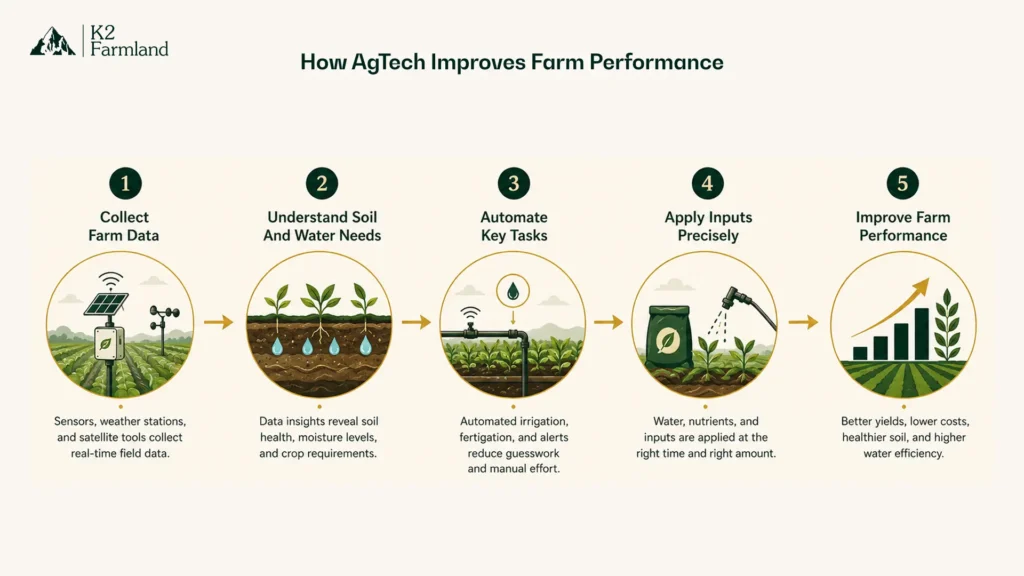
Precision tools are designed around one simple principle: apply the right action, in the right place, at the right time.
Instead of treating an entire farm as one uniform block, precision farming uses data from soil tests, sensors, satellite imagery, drones, weather systems, and field observations to understand variation. One part of a field may need more water. Another may need nutrient correction. Another may show early pest pressure. Another may be performing well and need no extra input.
CEEW explains that precision farming uses information technology to ensure crops and soil receive exactly what they need for optimum health and productivity. It also notes that precision farming practices can reduce nitrogen fertilizer use and that drip and sprinkler systems can yield significant water savings, depending on the crop and context.
For farm performance, this creates several benefits.
It reduces input waste because fertilizer, water, and crop protection can be applied as needed. It improves crop health by enabling earlier detection of stress. It supports better planning because yield forecasting and weather intelligence can guide decisions on sowing, irrigation, harvesting, and selling. It also improves accountability because farm managers can track what was done, when it was done, and how the farm responded.
Precision tools do not replace agronomy. They strengthen it. The best results come when technology is interpreted by experienced operators who understand the land.
What This Means For Soil, Water, Yield, And Profitability
The real test of agtech is not whether it looks advanced. The real test is whether it improves farm performance.
For soil, technology helps operators monitor soil organic carbon, nutrient needs, moisture behavior, and long-term fertility. K2 tracks soil organic carbon because it is directly linked to long-term fertility, yield stability, and asset value.
For water, precision irrigation and rainwater harvesting can make farms more resilient to drought. K2’s impact framework specifically includes improved water use efficiency and water use per kilogram of produce as key performance measures.
For yield, technology improves visibility. A farm manager can detect crop stress earlier, better understand field variability, and make faster decisions. This can help reduce avoidable losses and improve consistency across seasons.
For profitability, technology helps connect inputs to outputs. It becomes easier to see which practices are improving yield, which costs are unnecessary, and which parts of the farm need intervention. This is especially important for managed farmland models, where performance must be measured, reported, and improved over time.
Agtech in India is therefore not just a productivity story. It is a risk management story. It helps reduce uncertainty in a sector where weather, labor, water, pests, and market conditions can shift quickly.
Why K2’s Operator-Led Model Matters
Technology alone does not improve farmland. Operators do.
This is where K2’s model is especially relevant. K2 is not positioned as a passive landowner. Its approach is based on active stewardship, operational execution, and long-term value creation. The company focuses on transforming underperforming farmland into productive, resilient assets through soil improvement, water-smart practices, diversified cropping systems, and technology-led monitoring.
K2 also uses regenerative techniques such as cover cropping, intercropping, compost systems, reduced tillage, precision irrigation, and rainwater harvesting. Its farms are designed as diversified systems that reduce risk, improve resilience, and create multiple income streams.
This is important because the future of farming in India will not be won by technology alone. It will be won by integrated operating systems, where agronomy, capital, local teams, digital tools, and long-term stewardship work together.
That is why “tech not available in India” is becoming an outdated idea. The new question is different. Who can deploy the technology well enough to improve land performance year after year?
For K2, the answer lies in combining modern agtech with disciplined farm operations. The goal is not to chase every new tool. The goal is to use the right technology to build healthier soil, improve water efficiency, increase productivity, reduce avoidable risk, and create long-term farmland value.
FAQs
What Is AgTech In India?
Agtech in India refers to the use of technology across farming and the agricultural value chain. It includes farm automation, precision tools, AI advisories, drones, satellite monitoring, soil sensors, digital marketplaces, quality grading, credit, insurance, and farm management platforms.
Why Was Advanced Farm Technology Not Easily Available In India Earlier?
Many tools were expensive, designed for larger farms, dependent on strong connectivity, or unsupported by local service networks. Indian farms also vary widely by crop, climate, land size, soil type, and access to water, which makes direct adoption difficult.
Why Is AgTech In India Changing Fast Now?
The change is being driven by digital public infrastructure, rural internet access, startup innovation, government support, service-based models, and growing demand for better farm productivity. The Digital Agriculture Mission and AgriStack are also creating a stronger data foundation for digital agriculture.
How Does Farm Automation Help Farmers?
Farm automation helps reduce manual delays, improve timing, and streamline repetitive tasks. It can support irrigation control, crop monitoring, drone spraying, machinery access, weather-based planning, and digital record-keeping.
What Are Precision Tools In Farming?
Precision tools are technologies that help farmers apply inputs more accurately. These may include soil sensors, GPS mapping, drones, satellite imagery, weather tools, irrigation controllers, and AI-based crop monitoring systems.
Can Small Farmers Use AgTech In India?
Yes, but access models matter. Shared services, farmer-producer organizations, custom hiring centers, mobile advisories, and managed farm platforms can make technology more practical for small and marginal farmers.
How Does K2 Use Technology In Farming?
K2 integrates ag-tech to monitor soil health, water use, and productivity across its farms. It also tracks financial, environmental, and operational metrics to support transparent farm performance management.
Conclusion
The phrase “tech not available in India” is becoming less accurate every year. The tools are arriving, but more importantly, the systems around the tools are maturing. Digital infrastructure, startup innovation, precision farming, farm automation, and operator-led models are making modern agriculture more practical for Indian conditions.
For farm performance, this shift is powerful. It means better visibility, faster decisions, more efficient inputs, stronger water management, healthier soil, and more resilient farmland assets. For K2, this means a clear philosophy: technology must serve the land, improve operations, and create durable, long-term value.
Key Takeaway
- Agtech in India is shifting from early promise to practical farm-level adoption.
- Farm automation is becoming increasingly useful for irrigation control, monitoring, drone use, equipment access, and digital recordkeeping.
- Precision tools help improve input efficiency, water use, crop health, and yield consistency.
- Government digital infrastructure, including AgriStack and Krishi-DSS, is strengthening the foundation for scalable farm technology.
- K2’s operator-led model connects technology with regenerative farming, measurable performance, and long-term land value.