
The primary sector of the Indian economy, agriculture, is the backbone of the economy. This sector generates around 46% of employment but contributes only 18% to GDP. With higher labor costs and fragmented landholdings, farmers are having second thoughts about how work gets done on the land.
At the same time, technologies like drones and robotics are being promoted as the future of farming, leading the agriculture sector toward a structural inflection point, as drone spraying can decrease input costs and reduce water use. However, there are limitations in the farm mechanism, higher upfront costs, and increased labor shortages. And the result is a hybrid phase where technology is scaling but not yet universal.
This is where K2 Land Management comes in. It fills the gap by emphasizing the end-to-end land-and-farm mechanism rather than by relying on standalone tools.
This article takes a clear look at what drones and agri robotics can realistically deliver in agriculture in India right now, where they fall short, and how product-driven technology solutions are shaping the shift.
The Current State Of Indian Agriculture
The agriculture sector in India is the most labor-intensive, serving as the main economic foundation by providing jobs and accounting for a large share of the national GDP.
The current production and technological trends in Indian agriculture are as follows:
- High-Yielding Variety Seeds
Farmers who regularly plant HYV seeds for rice, wheat, and maize will achieve better harvests, especially in Punjab and Haryana.
- Production Transformation
Domestic and export markets receive their products through horticulture, which focuses on fruit and vegetable production and short-cycle crops, and livestock breeding.
- Mobile Apps
About 60% of farmers use mobile applications to receive weather updates, market price information, pest warnings, and crop protection recommendations. The applications provide users with information on when to sow crops, current market prices, and available subsidies.
- Drones and Satellite Monitoring
Farmers achieve greater efficiency through the widespread use of drones, which they employ to spray fields, monitor crop health, and create field maps. Farmers use satellite-based farm management systems to optimize their operations.
- AI & Machine Learning
Predictive analytics identify pest outbreaks, soil health issues, and climate change threats by generating accurate reports at scheduled time points.
- IoT-Enabled Irrigation
The IoT connects current irrigation systems to its network, resulting in better water use by reducing water loss and enhancing environmental protection against both rainfall and drought.
The agricultural sector is experiencing a significant transformation due to multiple obstacles, including climate change, water shortages, land fragmentation, infrastructure problems, and post-harvest losses.
What Drones In Agriculture Can Do Today?
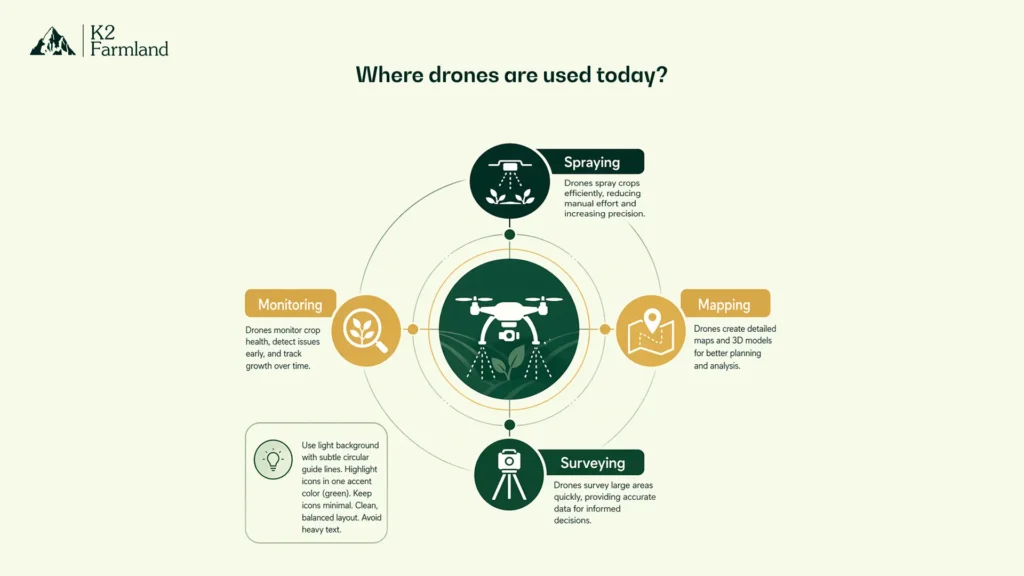
The economy now sees widespread drone use, with agriculture reaching its highest level. Drones serve the agricultural industry through their various applications.
- Monitoring plant health
Drones allow land assessment through aerial monitoring. The drone’s special imaging equipment uses detailed color information to highlight plant health. The system enables farmers to monitor their crop health. Farmers use satellite imagery to assess crop development and field density, and to identify crop issues that threaten their harvest.
- Focusing on field conditions
Drones are also used to monitor soil health and field conditions. It provides appropriate field mapping, including elevation data, enabling farmers to identify irregularities in the field. Having information on field elevation is important for determining drainage patterns and efficient watering techniques.
- Spray Application
A drone is used to apply spraying. Drone sprayers can reach areas where human intervention is not possible, such as steep tea fields at higher elevations. Also, this drone sprayer helps protect the health of backpack sprayers. Drones allow targeted spray applications to maximize efficiency and reduce chemical costs.
From inspection to security, drones will become indispensable on large and small farms in a few years.
Uses Of Agri Robotics In India
India is using robotics technology to transform its traditional agricultural methods through modern farming practices. Agricultural automation adoption in farming systems is driven by three main factors: growing labor shortages, rising operational expenses, and the need to boost output. The real use case includes:
- Concise Farming
The agricultural sector uses technology to monitor and optimize its entire production process. Farmers use robots equipped with built-in sensors and GPS to apply water and pesticides with precision, helping them minimize waste and increase productivity.
- Automated Harvesting
Robots help pick ripe fruits and vegetables from plants, which decreases the need for workers to do this task. These machines are essential for large-scale agricultural operations, which require farmers to bring in their harvests at specific times.
- Pest Control
Autonomous robots can identify weeds and remove or treat them with precision. The process reduces chemical emissions while ensuring no damage to the surrounding environment. Innovations, such as hybrid drone-rover vehicles, are well-suited for such operations.
- Irrigation Management
Farmers can use Nano Ganesh systems to operate irrigation pumps on their mobile devices, allowing them to better manage water use while reducing the need to visit fields for irrigation control.
The Digital India and Make in India government programs have raised Research and Development capacity for smart farming systems while promoting the cost-effective implementation of agricultural robotics technology.
What Still Feels Like Hype?
The agriculture sector today uses drones and robotic systems as standard equipment, although some of these technologies still serve more as promotional tools than as operational equipment.
- Drones
- Hype: Drones offer instant, comprehensive intelligence to resolve field issues.
- Reality: Drones generate vast amounts of imagery, but transforming it into actionable insights still requires significant human expertise.
- Operational Hype: Drones can spray 3 acres per hour, but their battery life is a major limiting factor for large-scale operations, as they require frequent charging.
- Robotics
- Hype: Agri-robotic harvesters will resolve labor shortages by selecting delicate fruits and vegetables.
- Reality: Agri robotics excels at repetitive tasks such as milking, but robots still struggle to match human dexterity, speed, and judgment in harvesting crops.
- Unshaped environment: Robots become experts in greenhouse settings, but often struggle to navigate complicated terrain or to operate efficiently in unstable weather conditions.
Despite the hype, the industry is moving rapidly toward Drone-as-a-Service (DaaS) models, which help reduce high capital costs by renting specialized drones with pilots.
How Technology Is Delivering Measurable ROI?
Drones and robotics are delivering significant ROI in agriculture by shifting from labor-intensive traditional practices to automated, data-driven precision farming. The key areas include:
- Precision Spraying
Drone applicators minimize chemical and fertilizer use by 20-40% compared to traditional methods by targeting specific areas. They include high-precision spraying, cost-cutting on pesticides, and increasing productivity.
- Frequent Crop Monitoring
Drones are equipped with multispectral sensors that detect water stress, plant deficiencies, and diseases at early stages to prevent crop loss and optimize fertilizer application.
- Labour Efficiency
Drones are significantly faster than human labor. Thus, it can cover 1 acre of land in 8-15 minutes, compared to an hour of manual spraying.
- Robotic Harvesting
Autonomous robots and laser weeders minimize labor requirements, increase harvesting speed, and reduce post-harvest loss.
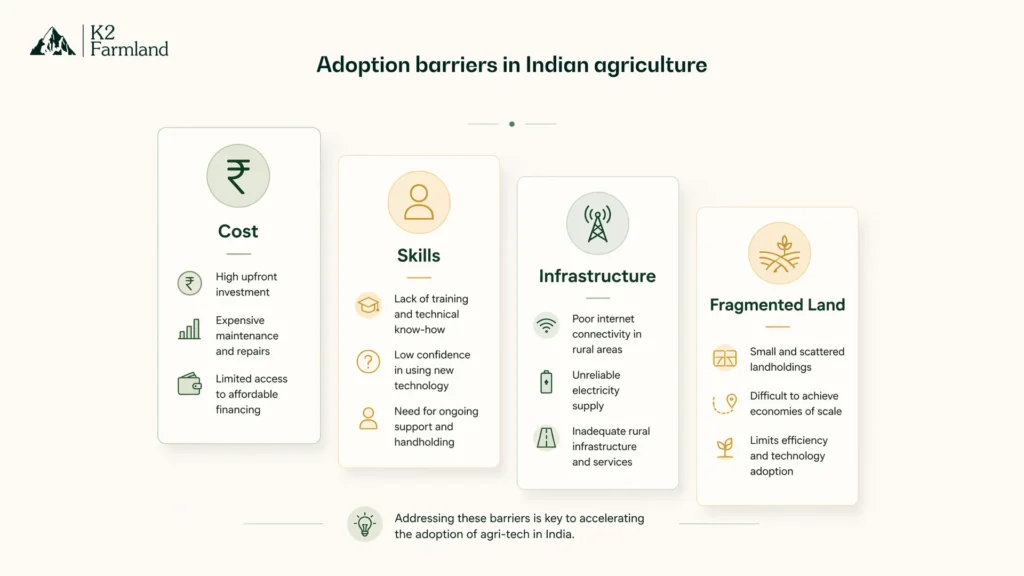
Challenges Slowing Down Adoption
Despite the significant benefits, several challenges prevent the widespread adoption of this technology in agriculture.
- Higher initial cost
The investment needs for robotic equipment and drones can be a burden for small and marginal farmers.
- Lack of technical skillset
Operating and managing advanced machinery requires specialized knowledge that may not be available in rural areas.
- Infrastructure Limitations
Power supply and internet connectivity shortages can affect the operation of drones and robotic systems.
- Cultural Resistance
Traditional farming practices are deeply rooted, and there may be an unwillingness to adopt new technologies.
What To Expect In the Next 5 Years?
The agriculture drone market has proved that future farming will be airborne. With smart tech, improved connectivity, and wider access, drones are helping farmers grow more with less water, fewer chemicals, and lower costs.
The prospects for the next 5 years include:
- Increased production and improved product quality due to intensive monitoring and rapid response to agricultural changes.
- Optimization of production costs and reduction of human labor.
- Reduction of human error and the probability of mistakes.
- Increased competitiveness in the global market through these advanced technologies.
In the next 5 years, we can expect even more innovation in autonomous drone fleets, real-time weather updates, and AI-driven farm decisions. Thus, agriculture is no longer on the ground, but it will be in the sky.
Role Of Product + Tech Companies In Driving Adoption with K2 Farmland
Product and technology companies, including K2 Farmland, are the primary drivers of drone and robotics adoption in the agriculture sector. The roles include:
- Use of proprietary networks to source high-potential lands in the most productive agro-climatic zones in India. We de-risk the acquisition by ensuring the resilience fundamentals of all assets.
- We protect the capital with strong and institutional-grade care. We analyze every property thoroughly, assess soil and water quality, and ensure full regulatory compliance.
- We acquire selected assets and convert them into high-efficiency operations through targeted technological and management interference.
- We provide regular, structured updates on the asset’s performance, land condition, and rental payouts.
K2 Farmland is transforming a traditionally labor-intensive industry into one that anticipates challenges and leverages data‑driven insights to achieve smarter, more sustainable outcomes.
FAQs
What is the role of robotics in sustainable farming?
Robotics enables precise application of inputs, such as water and fertilizers, reducing waste and environmental impact and promoting sustainability.
Are these technologies widely adopted in India?
Adoption is growing, but it remains in the early stages, especially outside pilot programs and on large farms.
Are there any training programs for farmers to learn these technologies?
Yes, several government and private initiatives offer training programs to educate farmers on these agricultural technologies, such as robotics and drones.
Conclusion
In the Indian agricultural sector, the use of robotics and drones is no longer an option. In certain areas, especially where labor and efficiency issues are concerned, these technologies are providing value. Both drones and robotics are increasingly important, from crop monitoring to rapid spraying.
However, not every promise is kept. Budget-friendliness, accessibility, and utilization are the vital factors in adoption, specifically in a nation where small landholdings are predominant.
This is where K2 Land Management comes in. Instead of using drones or robotics as standalone inventions, K2 Farmland combines them into a wider, product-driven approach to land and farm optimization. By integrating structured land development, resource planning, and the selective use of up-to-date technologies, they help farmers move from experimentation to significant outcomes.
Key Takeaways:
- By improving accuracy, minimizing chemical waste, and completing large-scale jobs quickly, drones are delivering significant value in monitoring and spraying.
- Despite its effectiveness, robotics is currently limited to certain uses, such as harvesting, sorting, and farming in restricted environments.
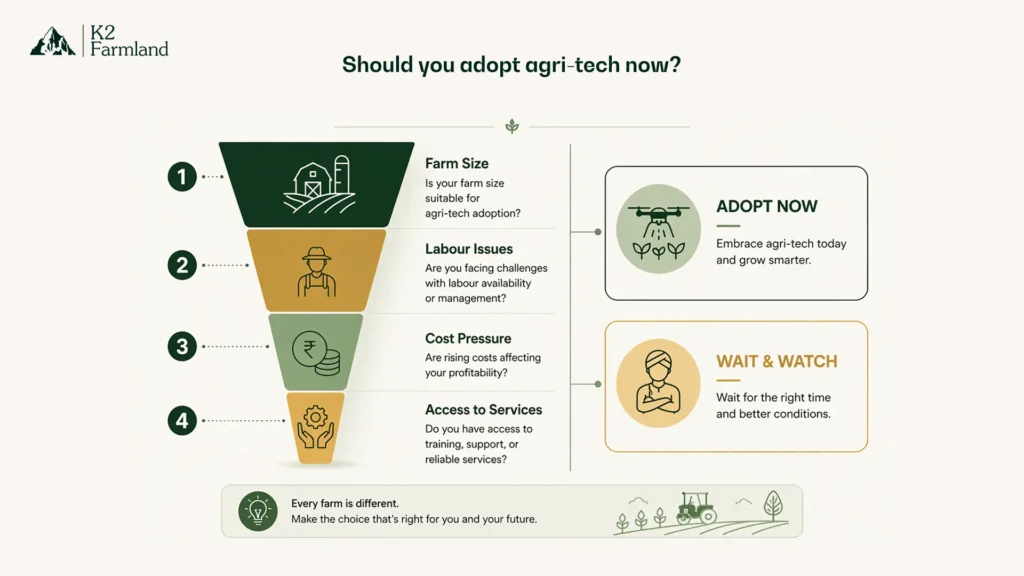
- Adoption is highly influenced by labor cost reductions, as farmers face labor shortages and rising wages across complex farming cycles.
- The agricultural sector will become more airborne and AI-based over the next five years, as drones use real-time monitoring and automation to enhance crop yields, minimize waste, and lower operational expenses.
- K2 Farmland will drive faster market adoption through its product and technology innovations, which leverage data intelligence, resilient asset management, and operational excellence to develop smarter, more sustainable farming methods.