
Rainfall does not automatically make a farm water-secure. A farm may receive good rain and still face dry wells, stressed crops, and poor soil moisture if most of that water runs off the land.
The real question is simple: how much rainwater enters the soil, moves downward, and supports groundwater over time?
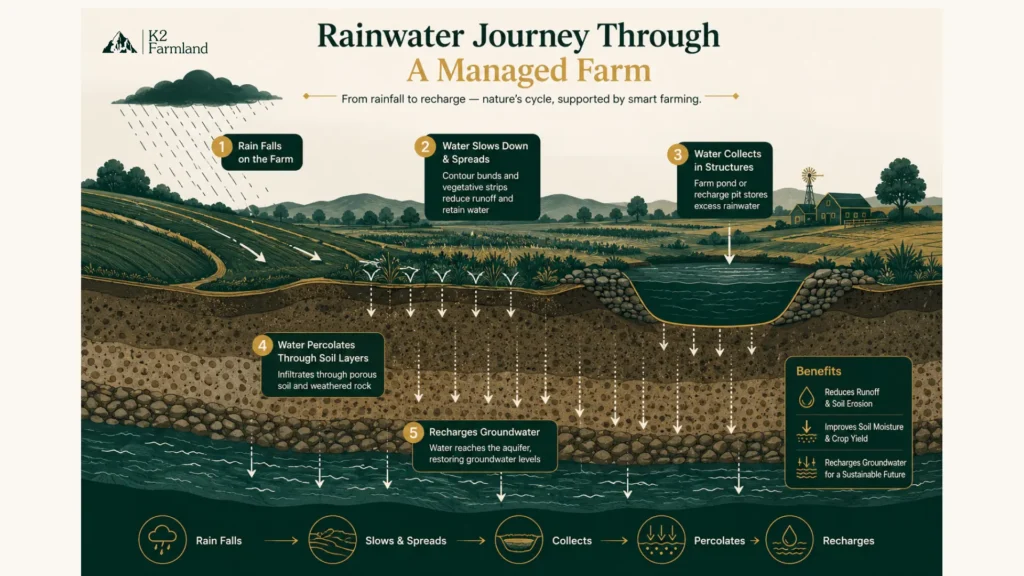
That is the heart of groundwater recharge farming. It is not only about building ponds or trenches. It is about designing the farm so that more rain slows down, spreads across the land, filters into the soil, and supports the aquifer rather than leaving as runoff.
For farm owners, operators, and investors, better recharge means stronger water resilience. It can improve soil moisture, reduce irrigation pressure, support crop stability, and protect long-term land value. At K2 Land Management, this directly connects to how farmland is managed, measured, and improved through regenerative systems, rainwater harvesting, precision irrigation, and transparent impact reporting.
What Groundwater Recharge Farming Means
Groundwater recharge farming is the practice of directing rainwater and surface water to enter the ground in a planned, useful, and measurable way.
In simple terms, recharge occurs when water moves underground and contributes to groundwater storage. This can happen naturally through soil, vegetation, streams, tanks, and low-lying areas. It can also be supported through farm-level and watershed-level interventions such as contour trenches, check dams, percolation tanks, recharge pits, farm ponds, and rainwater harvesting systems.
India’s groundwater position shows why this matters. According to the Ministry of Jal Shakti, India’s total annual groundwater recharge was assessed at 446.90 BCM in 2024, with annual extraction at 245.64 BCM. The ministry also reported that recharge from tanks, ponds, and water conservation structures increased from 13.98 BCM in 2017 to 25.34 BCM in 2024.
For farms, this means that water conservation structures can play a real role, but only when they are properly placed, maintained, and measured.
Why Water Percolation Matters For Farm Performance
Water percolation is the downward movement of water through the soil profile. It starts after water enters the surface and continues as water moves deeper through soil pores, cracks, root channels, and weathered rock.
Good percolation helps a farm in several ways.
It improves soil moisture after rainfall. It reduces surface runoff and erosion. It supports wells and borewells over time. It helps crops withstand short dry periods. It also reduces the need to irrigate as often, which can lower pumping pressure and improve water-use efficiency.
This is especially important in Indian agriculture because groundwater remains deeply connected to irrigation. The World Bank has noted that more than 60% of India’s irrigated agriculture and 85% of drinking water supplies depend on groundwater.
From a farm performance perspective, water percolation is not just an environmental metric. It is an operational metric. If a farm captures rain but cannot move it into the soil, the benefit is temporary. If the farm improves infiltration, percolation, and storage, the benefit can support multiple crop cycles.
What Improves Percolation On Farms
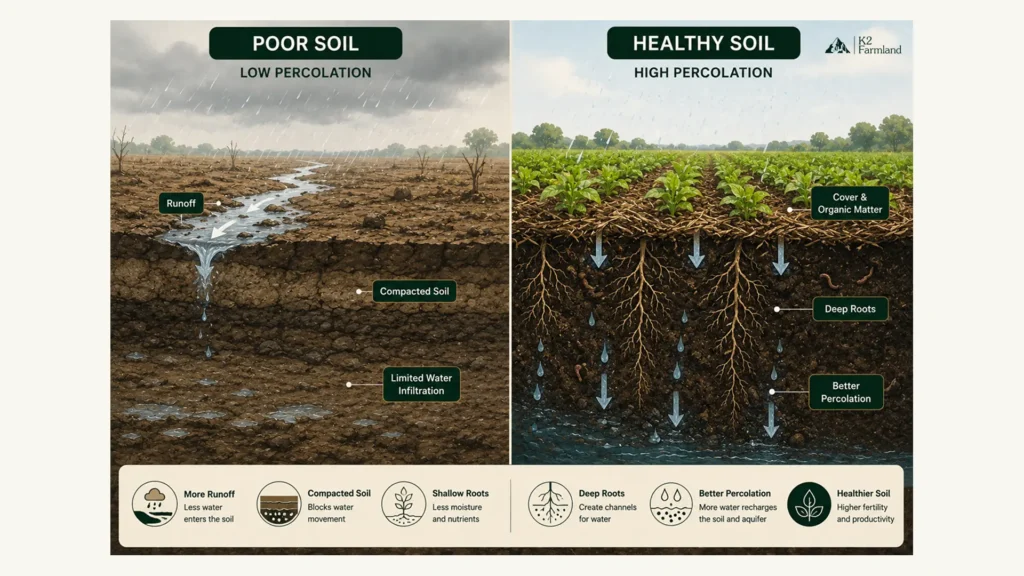
The first step is improving the soil itself. Healthy soil behaves like a living sponge. It has pores, root channels, organic matter, and biological activity that help water enter and move downward.
Organic matter is important because it improves aggregation. Well-aggregated soils allow better water entry and reduce the risk of erosion. USDA’s soil infiltration guidance explains that infiltration rate measures how fast water enters soil and that well-aggregated soils generally have a higher infiltration rate.
On farms, percolation usually improves when operators focus on these conditions:
- Keep Soil Covered
Bare soil seals quickly under heavy rain. Cover crops, crop residue, mulch, and groundcover reduce raindrop impact and help water enter the soil more gently. - Increase Organic Matter
Compost, green manure, cover cropping, and reduced residue burning improve soil structure. Better structure creates pore spaces that allow water movement. - Reduce Compaction
Heavy machinery, repeated tillage, and livestock pressure can compact soil. Compacted layers block downward movement and increase runoff. - Use Deep And Diverse Root Systems
Multi-crop systems, agroforestry, and cover crops create root channels. When old roots decay, they leave pathways that help water move deeper into the soil. - Shape Land Along Contours
Water moves fast on slopes. Contour farming, contour bunds, and contour trenches slow the flow, increase contact time, and reduce soil loss. - Irrigate Carefully
Over-irrigation can cause crusting, nutrient leaching, salinity issues, and waterlogging. Precision irrigation helps deliver water according to crop need and soil condition.
This is why groundwater recharge farming must combine soil practices with water structures. A farm pond can store water, but soil health determines how well the wider landscape absorbs rain.
Watershed Practices That Support Recharge
Recharge is strongest when the whole watershed is considered, not just one isolated field. A watershed is the natural drainage area where rainfall moves across land toward streams, tanks, ponds, and lower points.
FAO recommends implementing soil and water conservation practices on a catchment or watershed basis. It also notes that contour bunds, contour barriers, contour trenches, and contour stone walls can reduce soil erosion, obstruct runoff, increase soil moisture, and support groundwater recharge.
Useful watershed practices include:
- Contour Trenches
These are shallow trenches built along the contour line of a slope. They slow water, reduce erosion, and give rain more time to enter the soil. - Check Dams
Small barriers across drainage lines slow runoff and temporarily hold water. This increases percolation and reduces the speed of downstream flow. - Loose Boulder Structures
These are low-cost stone structures placed in small channels. They slow runoff, trap sediment, and improve moisture around drainage lines. - Percolation Tanks
CEEW describes percolation tanks as artificially created water bodies that allow surface runoff to percolate and recharge groundwater. - Farm Ponds
Farm ponds store rainwater for later use. Depending on the soil and design, they can also support recharge, especially when built in suitable locations and maintained to prevent excessive siltation. - Recharge Pits And Shafts
These structures help direct filtered rainwater into deeper permeable layers. They must be designed carefully to avoid contaminating groundwater. - Vegetative Barriers
Grass strips, hedges, tree lines, and agroforestry belts slow water movement and reduce soil loss. - Drainage Line Treatment
Instead of letting water cut through the farm, drainage lines can be stabilized and used to slow, spread, and sink rainwater.
The best approach is rarely one structure. It is usually a sequence of practices across slope, soil, drainage, vegetation, and storage.
How To Measure Groundwater Recharge On Farms
A common mistake is assuming that a recharge structure works simply because it fills with water during the monsoon. Filling is not the same as recharging. To know whether a farm is improving water percolation and groundwater recharge, operators need a measurement system.
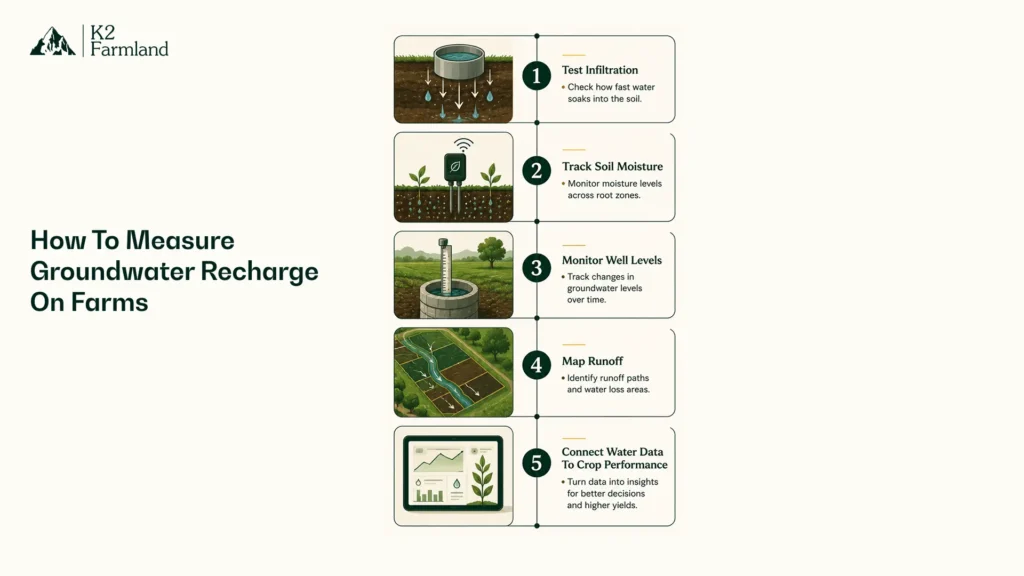
The simplest farm-level approach includes five layers of measurement.
1. Measure Infiltration Rate
Infiltration rate shows how quickly water enters the soil. FAO explains that the infiltration rate is usually measured as the depth of water, in millimeters, that enters the soil in one hour. For example, an infiltration rate of 15 mm per hour means a 15 mm layer of water can enter the soil in one hour.
A farm operator can run simple field infiltration tests before and after soil improvement practices. Testing should be conducted at the same marked locations each season, such as cropped fields, compacted pathways, orchard zones, and recharge-structure catchments.
2. Track Soil Moisture
Soil moisture readings help indicate whether water remains available in the root zone after rainfall. This can be measured with sensors, manual probes, or scheduled field observations.
Improving soil moisture does not always mean groundwater recharge has increased, but it is an important early indicator. If soil moisture improves and runoff declines, the farm is moving in the right direction.
3. Monitor Well And Borewell Levels
Water table movement is one of the strongest indicators of groundwater response. USGS explains that the water-table fluctuation method estimates groundwater recharge by analyzing water-level fluctuations in observation wells, assuming that a rise in water-table elevation in shallow wells is caused by recharge.
On farms, this can be made practical by recording pre-monsoon and post-monsoon water levels in wells or observation points. The same points should be measured each year, and readings should be compared with rainfall data and pumping records.
4. Record Runoff And Erosion
Recharge improves when runoff slows. Operators can monitor runoff pathways after heavy rain, note where water exits the farm, and record erosion marks, silt deposits, or gully formation.
If contour trenches, bunds, or vegetative barriers are working, runoff should become slower, less erosive, and more distributed across the landscape.
5. Connect Water Data To Crop Performance
Groundwater recharge farming should eventually show up in farm performance. Useful indicators include irrigation frequency, water use per kg of produce, crop stress days, dry-season survival, yield stability, and pumping hours.
This is where K2’s approach is especially relevant. K2’s impact reporting includes water use per kg of produce, improvements in soil organic carbon, changes in biodiversity, and regular ESG performance reporting.
Measurement makes water stewardship visible. Without data, recharge remains a good intention. With data, it becomes a farm management system.
Common Mistakes That Reduce Recharge
Groundwater recharge farming can fail when structures are built without understanding the land.
One common mistake is placing recharge structures where the soil or geology does not allow effective percolation. Another is ignoring silt. When tanks, ponds, and trenches fill with sediment, their capacity and percolation performance decline.
Poor maintenance is another issue. Bunds break, trenches collapse, vegetation dies, and drainage channels get blocked. Recharge systems need seasonal inspection, especially before and after the monsoon.
Water quality also matters. Recharge pits and shafts should not receive polluted runoff, chemical wash water, or contaminated drainage. The Ministry of Jal Shakti has highlighted that groundwater quality monitoring is important because pollutants such as arsenic, fluoride, chloride, uranium, nitrate, and elevated electrical conductivity can create long-term risks.
The final mistake is focusing only on supply while ignoring extraction. Recharge cannot solve groundwater stress if pumping continues without discipline. The farm must improve both sides of the equation, more water entering the ground and smarter water use in the field.
How K2 Builds Water Resilience Into Farmland
At K2 Land Management, water is not treated as a side issue. It is part of the operating model for building resilient farmland.
K2 focuses on transforming underperforming farmland into productive, durable assets. Its approach includes improving soil health, diversifying crops, optimizing productivity, and using operational expertise to unlock long-term land value.
This matters for groundwater recharge because water performance depends on management. A farm needs the right soil practices, the right recharge structures, the right irrigation system, and the right monitoring process.
K2’s impact framework includes improved water use efficiency through precision irrigation and rainwater harvesting. It also tracks soil organic carbon because more organic matter in the soil supports long-term fertility, yield stability, and better water retention.
The result is a more complete model of water resilience. Instead of only asking whether a farm has access to water, K2 looks at how water is captured, absorbed, used, measured, and protected over time.
That is what modern farmland management requires. Groundwater recharge farming is not just about conserving water. It is about building farms that can perform through dry spells, changing rainfall patterns, and rising pressure on natural resources.
FAQs
What Is Groundwater Recharge Farming?
Groundwater recharge farming is the practice of helping rainwater and surface water enter the soil and support groundwater storage. It includes soil health improvement, rainwater harvesting, percolation structures, watershed practices, and careful water use.
What Is The Difference Between Infiltration And Percolation?
Infiltration is the entry of water into the soil surface. Percolation is the downward movement of that water through the soil profile. Both are important, but percolation is more closely linked to deeper recharge.
Which Watershed Practices Improve Groundwater Recharge?
Common watershed practices include contour trenches, contour bunds, check dams, loose-boulder structures, percolation tanks, recharge pits, farm ponds, vegetative barriers, and drainage-line treatment.
How Do You Measure Water Percolation On A Farm?
Water percolation can be assessed through infiltration tests, soil moisture tracking, observation of pond or trench drawdown, well-level monitoring, runoff mapping, and long-term comparison of pre- and post-monsoon water levels.
Do Farm Ponds Recharge Groundwater?
Farm ponds can support recharge if they are located in soils and geological conditions that are suitable for recharge. Some ponds are designed mainly for storage, while others are designed to encourage percolation. Maintenance and desilting are important.
How Does Soil Health Affect Groundwater Recharge?
Healthy soil has better structure, organic matter, root channels, and biological activity. These improve water entry, reduce runoff, and support deeper movement of water through the soil.
How Does K2 Support Water Resilience On Farms?
K2 supports water resilience through rainwater harvesting, precision irrigation, improving soil organic carbon, diversified cropping systems, farm monitoring, and transparent reporting on water and environmental performance.
Conclusion
Groundwater recharge on farms begins with a simple principle: slow the water, spread it across the land, help it sink into the soil, and measure what changes.
Good recharge is not created by one pond, one trench, or one rainy season. It is built through soil health, contour-based planning, watershed practices, responsible irrigation, and consistent monitoring. The farms that do this well are better prepared for dry periods, changing rainfall, and long-term water stress.
For K2, groundwater-recharge farming aligns directly with the broader goal of building climate-resilient farmland. By combining regenerative practices, rainwater harvesting, precision irrigation, and measurable reporting, K2 turns water stewardship into a core part of farm performance and asset value.
Key Takeaways:
- Groundwater recharge farming helps more rainwater enter the soil, supporting long-term water security.
- Water percolation improves when soil is covered, biologically active, less compacted, and rich in organic matter.
- Watershed practices such as contour trenches, check dams, percolation tanks, farm ponds, and vegetative barriers slow runoff and support recharge.
- Recharge should be measured through infiltration tests, soil moisture, well levels, runoff patterns, and water use per kg of produce.
- K2’s operator-led model connects recharge practices with measurable farm performance, water efficiency, soil health, and long-term land value.
One Response