
Farmland rarely produces eye-catching returns by accident.
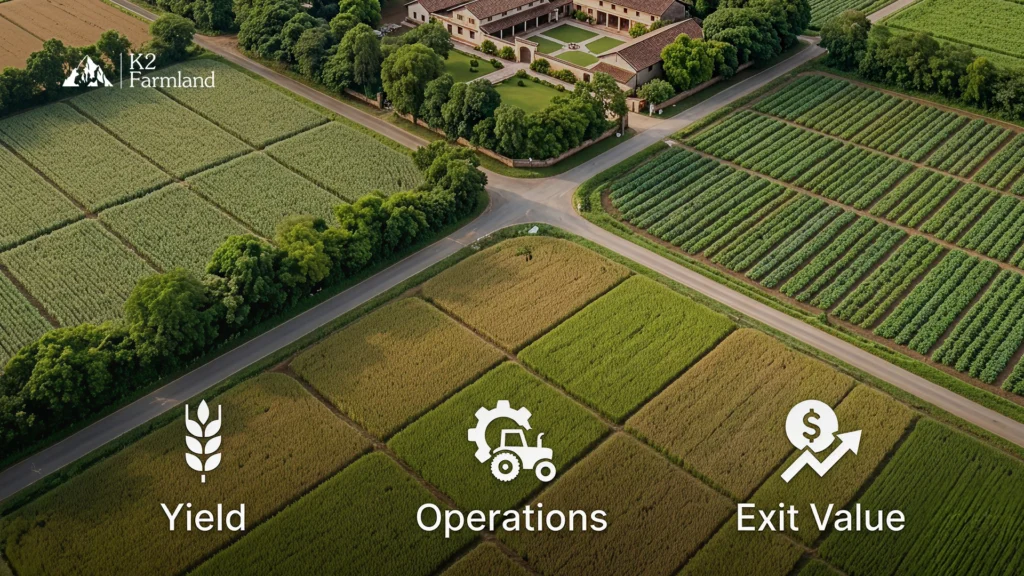
The strongest farmland investment returns tend to be engineered, through disciplined yield capture, operational upgrades that increase what the land can produce, and an exit that reflects the land’s improved quality and resilience.
This 2026 guide breaks down how farmland yield, IRR farmland underwriting, and value creation actually work, so you can evaluate opportunities with the mindset of an operator, not a brochure.
What “Farmland Investment Returns” Really Mean
At the simplest level, farmland total return has two components: income earned during the holding period, plus the change in land value.
That sounds basic, but it leads to the most important point for any investor evaluating farmland investment returns:
If you only focus on appreciation, you are guessing the exit.
If you only focus on yield, you may miss where most long-run value is created.
The goal is to understand, then underwrite, the full return bridge.
The Three Engines Of Farmland Returns
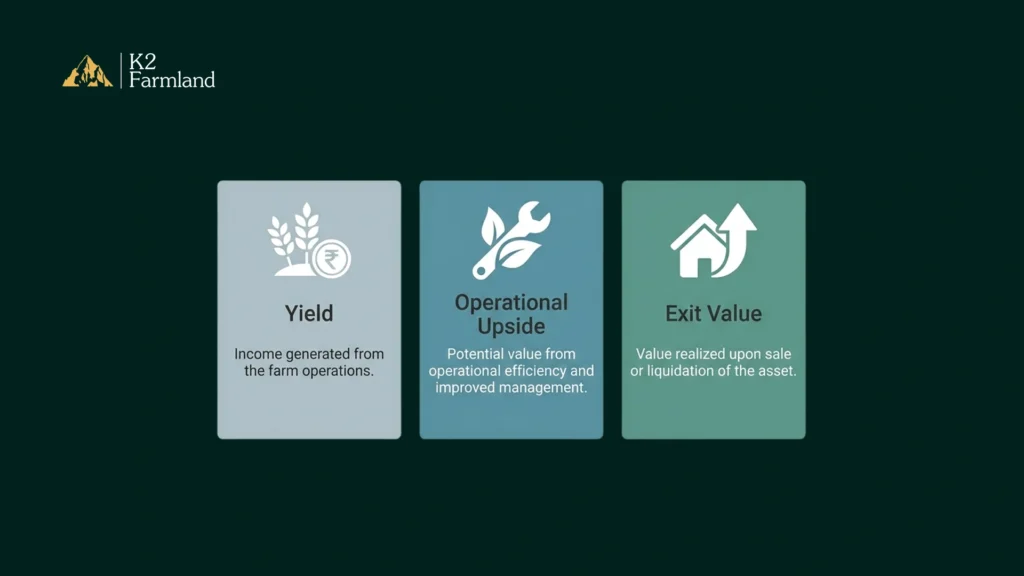
Yield: The Income Return That Keeps The Story Honest
Yield in an investment sense is the net income generated by the land, usually through cash rent, crop-share, or operating profit (after expenses).
A useful reference point from farmland modeling work is that cash yields are often modest and can vary by region and crop type.
For investors, the questions that matter are practical:
- Who is paying you, and how predictable is that payment?
- What costs sit above your income, like property taxes, insurance, management, and compliance?
- Whether the income is fixed, flexible (linked to yield and prices), or purely variable.
In K2Land Management models, the approach is framed as operator-led ownership, where partners receive a stable, fixed annual income through a lease arrangement, while K2 manages operations and reporting.
Operational Upside: Where “Operator Alpha” Comes From
Operational upside is the gap between what the land is doing today and what it could do with better systems.
In practice, this typically comes from improvements like:
- Soil health and fertility rebuilding, which supports durable productivity.
- Water security, irrigation efficiency, and drainage.
- Crop strategy changes, including diversification to reduce reliance on one revenue line.
- Better farm management, input discipline, harvesting, and go-to-market execution.
K2 Land Management’s positioning is explicit here: it describes converting underperforming monoculture farms into diversified agroforestry systems, designed to create multiple, non-correlated revenue streams.
Operational upside is also the part that most investors cannot do remotely, which is why manager capability matters as much as location.
Exit Value: Appreciation Plus Valuation Re-Rating
Exit value is not only “land prices went up.”
It is often the combined effect of:
- Market appreciation for the region and land type.
- Higher and more reliable net income, which can justify a higher valuation.
- Reduced risk, like clearer title, better infrastructure, stronger water reliability, and institutional-grade reporting.
In other words, the exit value is where operational work meets market pricing.
A concrete example from K2LM’s case study describes a 150-acre coffee estate that was operationally turned around through diversification and on-the-ground interventions, then sold to a strategic buyer, with a reported 3.1x gross return on invested capital by the end of Year 5.
That is what exit value creation looks like when operations change the asset, not just the narrative.
How IRR Works For Farmland
IRR farmland analysis is simply a way to summarize the timing of cash flows.
IRR rises when:
- You receive more cash sooner (stronger, earlier yield).
- The farm’s net income grows sustainably (operational upside).
- The exit price is higher than expected (appreciation and valuation uplift).
A simple way to think about it is a return bridge:
- Annual Net Income
- Plus land value change by exit
- Minus costs, taxes, fees, and any capex needed to generate that upside
Important: A multiple at exit is not automatically a high IRR if cash flows are delayed or costs balloon. Conversely, a moderate exit can still generate a strong IRR if the yield is steady and risks are tightly managed.
What The Data Says from 2024 To 2026
1) NCREIF Shows Why Income Matters
One of the most useful real-world lessons comes from a tough year.
AgIS Capital’s 2025 market report states that the NCREIF Total Farmland Index recorded a negative annual total return of about -1.0 percent for the year ending December 31, 2024, composed of roughly 2.5 percent income return and -3.5 percent capital return.
Takeaway: Farmland can still pay income while valuations soften, and crop types can behave very differently in the same year.
2) Global Value Growth Can Be Strong, But It Is Not The Whole Story
Savills reported that in 2024, its Global Farmland Index recorded an exceptional annual average increase of 18 percent, driven heavily by South America and currency movements.
That supports the “real asset” thesis, but it also reinforces why you should not treat appreciation as guaranteed, or evenly distributed across geographies.
3) India: Track Price Appreciation Separately From Yield
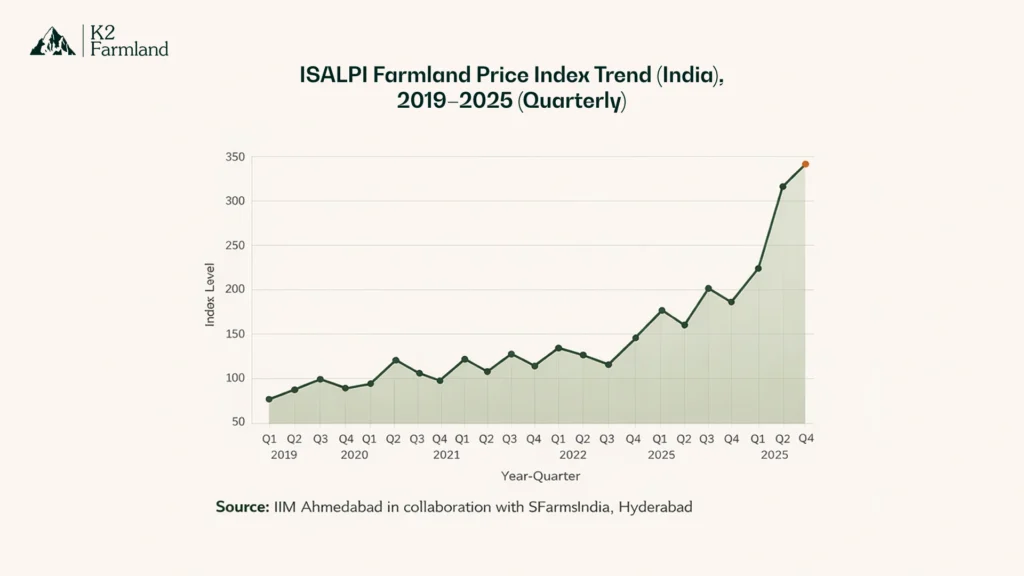
ISALPI, developed by IIM Ahmedabad in collaboration with SFarmsIndia, is explicitly a price index focused on capital appreciation, and it notes that a discount rate estimate must also include income yield, which it describes as usually small, in the range of about 1 to 2.5 percent per year.
In its December 2025 release, ISALPI reports long-term performance metrics including average year-on-year growth of 16.5 percent between January 2019 and November 2025, with additional multi-year CAGR figures presented in the highlights.
Two important investor implications:
- India farmland investing conversations often overfocus on appreciation, because yield is harder to verify remotely.
- The most investable strategies treat yield as underwritten cash flow, not as an afterthought.
Underwriting Checklist: What To Verify Before You Invest
If you want to evaluate farmland investment returns like a pro, focus on inputs you can verify.
Yield Underwriting Checks
- Contract structure: cash rent vs crop share vs operating exposure.
- Who bears variability risk, and what happens in a weak year?
- Net yield, after property taxes, insurance, management, and compliance.
Operational Upside Checks
- Baseline productivity and why it is underperforming.
- Water and soil diagnostics, and the capex plan tied to measurable outcomes.
- Operator capability: who is actually on the ground, and what they have executed before.
Exit Value Checks
- Who the likely buyers are, and what they value (scale, infrastructure, crop profile, compliance, reporting).
- How the strategy reduces risk and increases consistency, thereby supporting valuation.
- Your exit options, timeline, and decision rights.
How K2 Land Management Thinks About Building Returns
K2 Land Management emphasizes that it is not about passive ownership; it is about active stewardship and operational transformation.
A practical way to map their framing to the three engines:
Yield
K2LM describes a model in which partners receive stable annual income under a fixed-lease agreement, while K2LM handles operations, compliance, and reporting.
Operational Upside
The stated approach includes converting monoculture into diversified agroforestry systems, integrating multiple revenue streams, and using technology and management interventions to improve output and quality.
Exit Value
K2LM’s case study example explicitly ties operational transformation to a strategic exit, culminating in a stated 3.1x gross return on invested capital by Year 5.
If you are evaluating fit, K2 notes it works with a select group of investors and offers a virtual tour and consultation flow.
FAQs
What Are Typical Farmland Investment Returns?
Returns vary by geography, crop type, and operator skill. One referenced benchmark year shows how returns can split between positive income and negative appreciation, as seen in reported 2024 index outcomes.
Is Farmland Yield The Same As Crop Yield?
No. Farmland yield in investing usually means income yield, which is net income relative to the land’s value. Crop yield is production per acre and can influence income, but it is not the return in itself.
Why Do Permanent Crops Sometimes Have Bigger Swings?
Permanent crops can carry higher operational complexity and can be more sensitive to multi-year pricing cycles, which can affect valuations even when income remains positive.
How Do I Evaluate IRR Farmland Projections From A Manager?
Ask for a return bridge that shows income assumptions, capex, fees, appreciation assumptions, and exit logic. Then pressure-test what happens if income is flat, capex is delayed, or exit pricing is lower.
What Makes Managed Farmland “Investable” For A Busy Or Global Investor?
Clear structure, enforceable contracts, clean title, disciplined reporting, and a credible operating team. K2LM highlights institutional-grade due diligence and structured reporting as core to its process.
Conclusion
Farmland investment returns are built, not wished into existence. The most durable outcomes tend to come from three levers working together: income yield, operational upside, and exit value.
Key takeaways:
- Underwrite yield as real net income, not as a headline rent number.
- Operational upside is where operator skill shows up, through soil, water, diversification, and execution.
- Exit value improves when the asset becomes more productive and less risky, not only when the market rises.
- Use real-world data to stay grounded, including years when appreciation was negative, but income remained positive.
- If you want an operator-led approach, focus on diligence, reporting, and proof of execution, not only projections.