
A farm can look healthy on the surface: straight rows, one strong crop, predictable routines. Then one bad monsoon, one pest cycle, or one price dip hits, and the same “efficient” system suddenly feels fragile.
That is the core tension in farming in India today: the pressure to produce more, from smaller landholdings, under rising climate stress.
This article explains why monoculture often struggles over time, and how diversified agroforestry can improve resilience for farmers, and for anyone thinking long term about land, food security, and sustainable returns.
The Reality Of Farming In India Today
Farming in India is not one story. It spans rainfed and irrigated belts, tiny household farms and large estates, staple grains and high-value horticulture. Yet two structural facts keep appearing.
First, most agricultural households operate on small landholdings, which makes risk management and cash flow stability a daily priority.
Second, a large share of net sown area still depends on rainfall, and irrigation coverage remains incomplete. That means weather variability can quickly translate into yield and income shocks.
In this environment, a farming system is not just about yield. It is about resilience: the ability to keep producing, keep earning, and recover after stress.
What Monoculture Means In Indian Farming
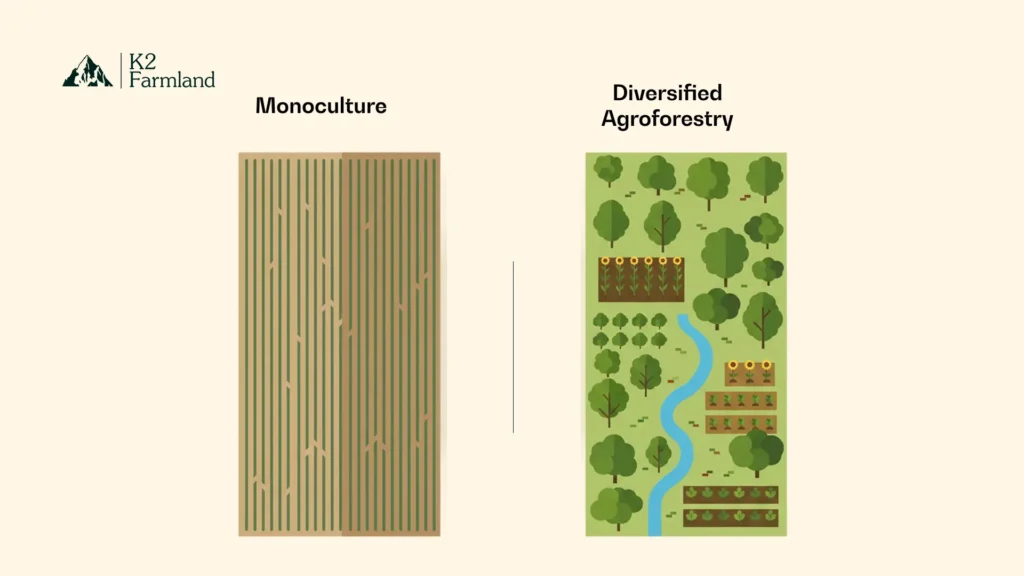
Monoculture is the practice of growing a single crop, or a single crop pattern, on the same land repeatedly. In India, that can look like a single-crop focus or a tight rotation that still behaves like monoculture because diversity stays low and the same inputs and risks repeat each season.
It became common for understandable reasons:
- Operational simplicity, one crop, one schedule, one input plan.
- Market familiarity, known buyers, known pricing cycles.
- Policy and procurement history that rewarded a narrow set of staples in key regions, shaping long-term cropping choices.
Monoculture can perform well in stable conditions. The problem is that conditions in Indian agriculture are getting less stable.
Why Monoculture Struggles Over Time
Soil Fatigue And Rising Input Dependence
A single crop repeated year after year pulls a similar nutrient profile from the soil. Over time, soil structure and organic matter can decline, and the system leans harder on fertilisers and chemicals to maintain yields.
Once that cycle begins, costs rise, biological life in the soil weakens, and the farm’s margin becomes more sensitive to any disruption.
Water Stress And Groundwater Decline
A narrow crop choice can also lock a region into water-intensive routines. Punjab’s paddy wheat dominance is the best-known example, with paddy requiring far more irrigation than wheat, contributing to groundwater stress.
Research also links groundwater decline patterns with paddy area expansion and irrigation intensity in parts of Punjab across multi-year periods.
When water becomes the limiting factor, monoculture becomes less a strategy and more a trap.
Pest And Disease Concentration Risk
Low diversity makes it easier for pests and pathogens to build momentum. When the same host crop is always present, outbreaks become more frequent and more expensive to control.
It is not just crop loss risk. It is also the cost of prevention, more sprays, more labour, more stress.
Price And Income Volatility
A single crop income is a single point of failure. If prices fall, or quality grades slip, the season’s economics can collapse. This is one reason many monoculture explainers highlight economic risk as a core disadvantage.
For small holdings, especially, income volatility is not theoretical. It affects repayment capacity, household spending, and the ability to invest in better practices.
Climate Shocks Hit Harder
When a system depends on a single crop window, a single rainfall pattern, and a single pest cycle, it has fewer ways to adapt mid-season. That is why resilience, not just yield, is increasingly the main game in Indian farming.
What Diversified Agroforestry Looks Like
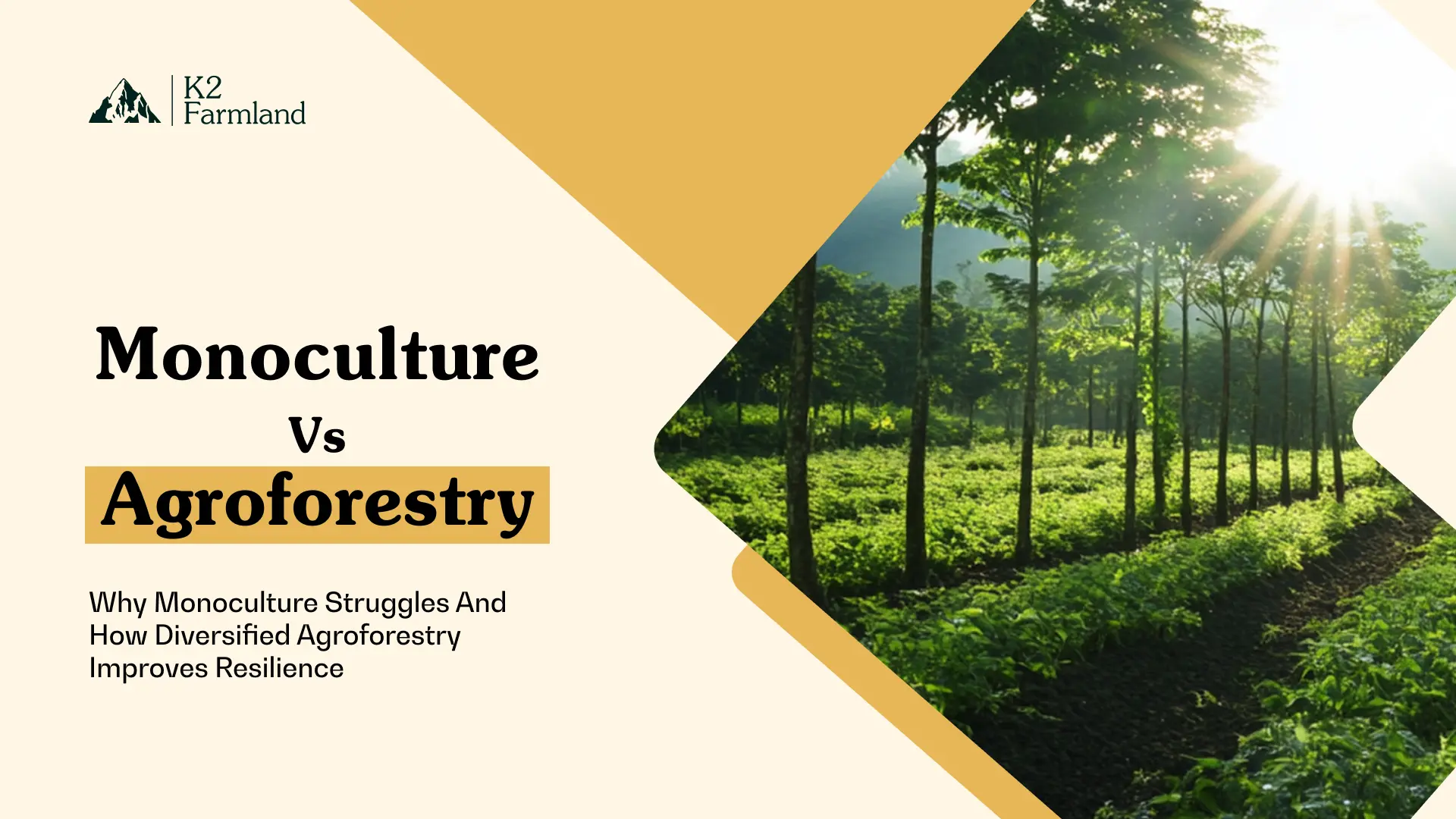
Diversified agroforestry integrates trees with crops and sometimes livestock on the same land, designed as a system rather than a tree-planting drive.
In practice, it often includes:
- Perennials for long-term value (timber, fruit, spice, fuelwood species)
- Short-cycle crops for cash flow while trees establish
- Optional livestock for nutrient cycling and additional income streams
- Multi-layer structure, canopy, and understory, which moderates microclimate and improves resource efficiency
This is not new to India. Agroforestry has deep traditional roots and gained modern policy momentum through the National Agroforestry Policy framework.
How Diversified Agroforestry Improves Resilience
Ecological Resilience: Soil, Water, Biodiversity
Agroforestry is repeatedly linked to stronger nutrient cycling, improved soil conditions, and better ecosystem health, largely because the farm begins to behave more like a living system and less like an extractive factory.
Trees contribute leaf litter, root biomass, and microclimate moderation. They can also reduce erosion and improve water infiltration in many contexts, which matters in both rainfed belts and irrigated regions facing groundwater decline.
Biodiversity gains also reduce the farm’s dependence on chemical inputs over time by supporting beneficial insects and balancing pest pressure.
Economic Resilience: Multiple Revenue Lines
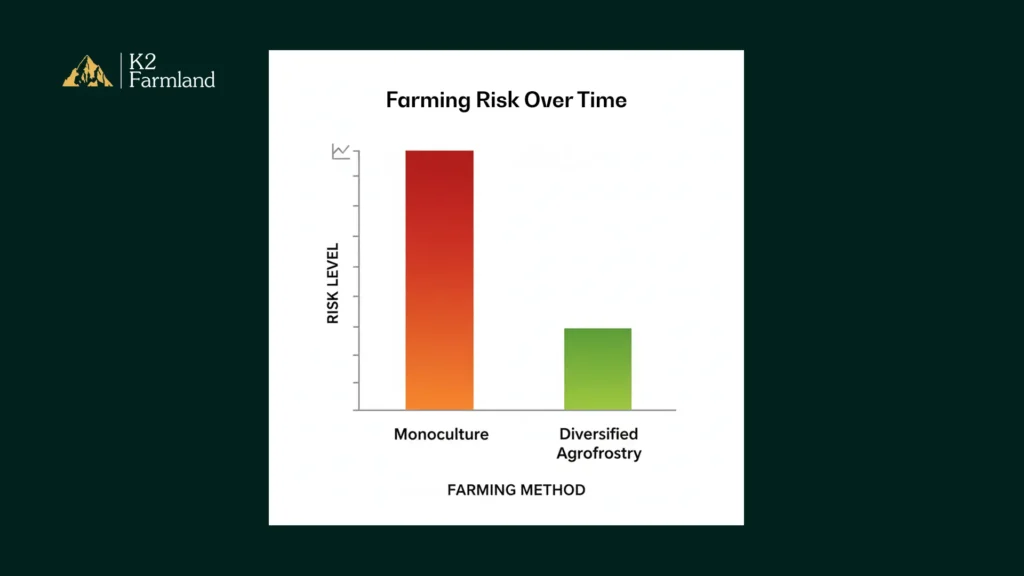
Diversified systems create multiple, less-correlated income streams. If one crop underperforms, another can still carry the season. That income spread can include annual crops, perennials, animal products, and value-added activities, depending on the site.
Policy framing in India also recognizes agroforestry as a way to improve livelihoods and resilience against climate threats and natural calamities.
Operational Resilience: More Options When Conditions Change
In a monoculture, mid-season adaptation is limited. In a diversified agroforestry layout, farmers can adjust crop mixes, harvest timing, and resource allocation. Diversity creates options, and options create resilience.
Monoculture Vs Diversified Agroforestry
Here is a simple comparison that reflects what farmers and land stewards experience on the ground.
| Factor | Monoculture | Diversified Agroforestry |
| Soil Health Over Time | Often declines without heavy inputs | Builds organic matter and nutrient cycling |
| Water Risk | Can be high if the crop is water-intensive | Better infiltration, shading, and system flexibility |
| Pest And Disease Risk | Higher concentration risk | Lower pressure through diversity and habitat balance |
| Income Stability | One main income stream | Multiple income streams across seasons and years |
| Climate Resilience | Fewer buffers | More buffers through structure and diversity |
| Management Complexity | Simpler short-term | More planning, but stronger long-term control |
A Practical Transition Plan
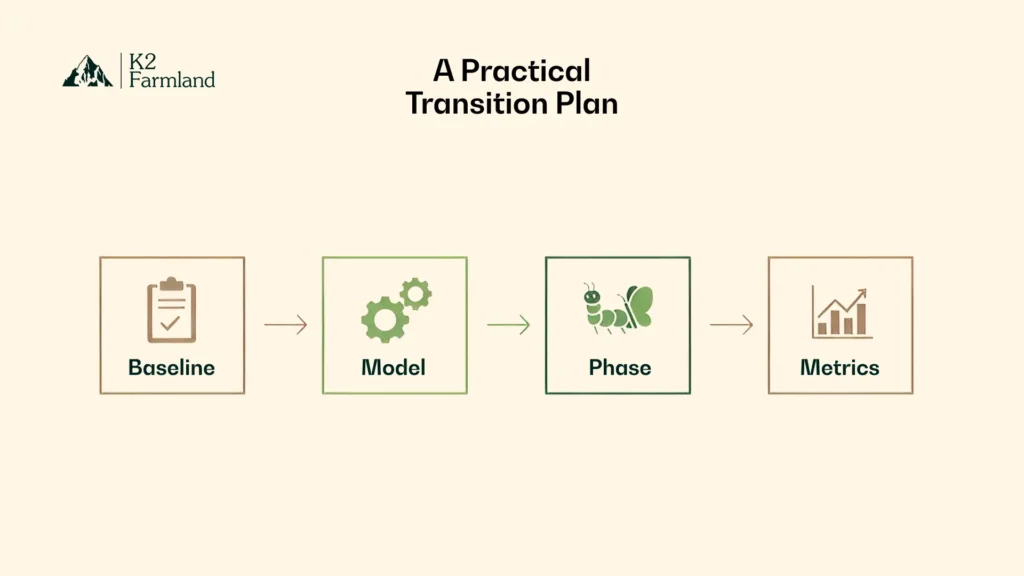
Agroforestry works best when it is treated as a designed transition, not an overnight switch.
Step 1: Establish A Baseline
Before planting, capture a basic baseline:
- Soil condition, including organic matter or SOC if testing is available
- Water source reliability, costs, and seasonal constraints
- Current crop margin, not just yield
- Key risks, pests, drought windows, price swings
This is the foundation for tracking real improvement, and it is also how serious stewards report progress over time.
Step 2: Pick A Model That Matches Your Ecology And Market
A good model fits three realities: rainfall, soil, and buyers. CEEW highlights agroforestry’s strength in diversity and resilience, but the exact combination must be locally designed.
Examples of common directions include:
- Timber plus intercrops for a longer horizon value
- Fruit tree rows with seasonal crops between
- Shade systems for plantation crops like coffee, with spices or vines beneath
Step 3: Phase The Transition To Protect Cash Flow
One practical approach is a phased layout:
- Keep a core portion under annual crops in Year 1
- Establish tree lines or blocks gradually
- Add intercrops that thrive with partial shade as the canopy develops
- Introduce livestock only when fodder and labour routines are ready
This reduces the “income gap” problem that many generic agroforestry articles fail to address.
Step 4: Track A Few Simple Resilience Metrics
If you track nothing else, track these:
- Soil organic carbon trend or proxy indicators, such as organic matter tests
- Water use efficiency or irrigation cost per acre
- Biodiversity indicators, even simple ones like crop count, tree species count, and pollinator activity
- Revenue diversity, number of distinct farm income lines per year
These metrics turn “sustainable” into measurable progress.
Common Barriers And How To Navigate Them
Regulatory And Market Friction
India’s agroforestry policy discussions have long noted barriers, including restrictive rules on harvesting and transporting certain tree species, weak extension services, and inadequate market infrastructure.
Practical ways to reduce friction include:
- Choose locally accepted species with clearer harvest and transit pathways
- Line up buyers early for timber, fruit, spice, or fodder outputs
- Work with experienced operators who understand compliance and logistics
Knowledge And Planting Material Quality
The system is only as good as its design and planting stock. Access to high-quality material and region-appropriate models is repeatedly cited as a constraint that needs institutional support.
Financing And Risk Management
Government programs focused on climate-resilient, integrated farming approaches, including rainfed area development, aim to reduce the risks associated with climatic variability.
Even when funding is not directly used, the logic is useful: integrate components, reduce single-point failure, and invest in water and soil first.
What Disciplined Stewardship Looks Like In Practice
A diversified system is not a theory. It is execution.
K2 Land Management describes an operator-led approach that converts underperforming monoculture farms into resilient, diversified agroforestry systems while measuring outcomes such as soil organic carbon, water-use efficiency, and biodiversity.
One publicly shared case study shows a coffee estate transitioning from monoculture to a multi-layered agroforestry system with shade-grown coffee under native trees, intercropped with black pepper, supported by a small dairy unit for closed-loop organic inputs, and an additional revenue stream from agri-tourism. The reported outcomes included improved soil organic carbon and water retention, and diversified income from multiple sources.
If you want to see how this is approached at a portfolio and reporting level, K2’s Impact framework and farm case studies are useful references.
FAQs
What Is Farming In India Mostly Dependent On
A significant part of India’s net sown area is rainfed, and irrigation does not cover the full farmland base, so monsoon variability still strongly affects outcomes.
Why Did Monoculture Become Popular In India
It offered operational simplicity, supported mechanisation and input standardisation, and aligned with established market channels in many regions.
Is Monoculture Always Bad
Not always. It can be productive under stable conditions, but it often becomes fragile over time due to soil, water, pest, and price risks that concentrate in a single-crop system.
What Is Diversified Agroforestry In Simple Terms
It is farming that combines trees with crops, and sometimes livestock, to produce multiple outputs and improve the land’s long-term health.
How Long Does Agroforestry Take To Pay Back
It depends on the mix. Annual intercrops can generate near-term cash flow, while perennials and timber build value over multiple years. A phased transition plan helps bridge the early years.
What Are The Biggest Challenges In Adopting Agroforestry
Common issues include regulatory friction in tree harvesting and transport, limited extension services, limited quality planting material, and weak market linkages in some regions.
How Can Resilience Be Measured On Farms
Track a small set of metrics, such as soil organic carbon, water-use efficiency, biodiversity indicators, and the number of distinct revenue streams.
Conclusion
Monoculture can seem efficient, but in many parts of India, it concentrates risk in the same place and at the same time each year. Diversified agroforestry spreads that risk, builds soil and water resilience, and creates multiple pathways to income.
Key takeaways:
- Monoculture concentrates soil, water, pest, and price risks into a single crop cycle.
- India’s farming reality, small holdings and weather exposure, makes resilience as important as yield.
- Diversified agroforestry improves resilience by strengthening ecosystems and diversifying income.
- The best transitions are phased, market-aligned, and measured with simple, repeatable metrics.
- Operator-led stewardship and transparent reporting make regeneration practical and investable, at scale.