
Farmland is one of the few assets you can touch, improve, and pass on, but for NRIs, it’s also one of the easiest places to make a costly compliance mistake.
If you’ve been exploring farmland investment because you want stability, a real-asset hedge, or a way to reconnect with India through productive land, this 2026 playbook will help you separate what’s legally possible from what’s simply being marketed.
This guide is informational and should be treated as a starting point, not a substitute for professional legal and tax advice. RBI rules and state land laws can materially change your options.

The 2026 Reality Check: What NRIs Can and Cannot Do
NRIs Generally Cannot Purchase Agricultural Land
RBI guidance is clear: an NRI can purchase immovable property in India other than agricultural land, plantation property, or a farmhouse.
That single line changes the entire “NRI farmland investment” conversation. It means most “buy farmland in India as an NRI” plans fail on day one, even if the land looks perfect and the price looks right.
Inheritance Is The Most Common Legit Entry Point
NRIs can typically acquire immovable property by inheritance, including agricultural land, provided the property was acquired in line with applicable laws at the time.
So in practice, many NRIs begin with inherited family land and then ask the real question: “How do I make this land productive, safe, and professionally managed while I live abroad?”
“India” Is Not One Rulebook
Even for resident Indians, the purchase and use of agricultural land are shaped by state laws, including ceilings, local eligibility requirements, tenancy protections, and land classification rules. This is why serious investors treat state selection and legal diligence as part of the investment thesis, not paperwork.
What “Farmland Investment” Actually Means In India
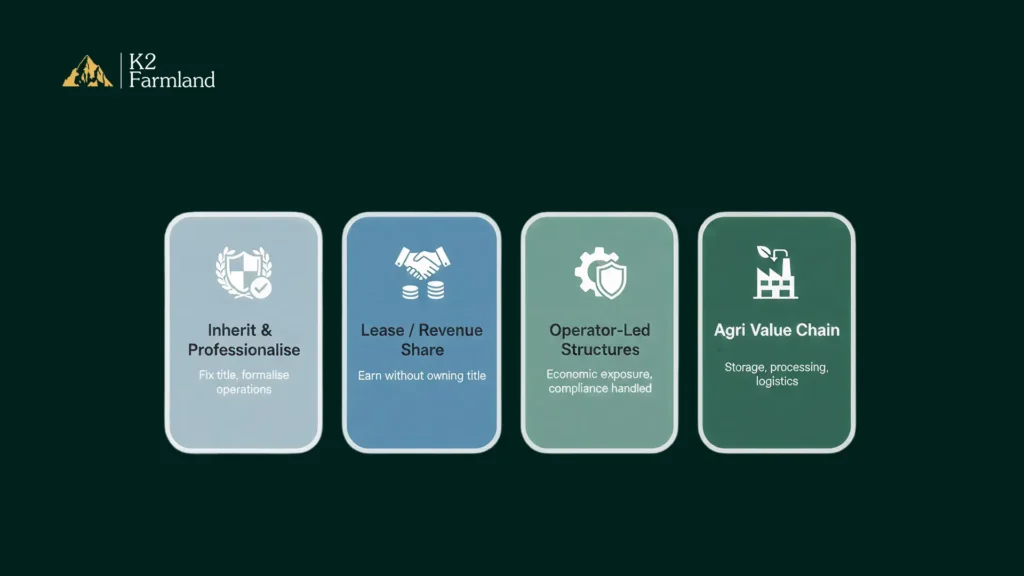
When people say farmland investing, they often mean one of four things:
- Owning land (title ownership) and earning from operations or leasing.
- Leasing land and earning from cultivation or revenue share.
- Managed farmland in India, modeling where an operator handles farming, compliance, and reporting for the investor.
- Investing in the agricultural value chain (warehousing, cold chain, processing), without touching land title.
The structure matters because farmland in India is also highly fragmented. The Agriculture Census reports that the average operational holding size was 1.08 hectares (and has been declining over time).
That fragmentation is one reason professional operators focus on consolidation, operational upgrades, water security, and governance rather than “plot buying.”
Four Practical, Compliant Routes For NRI Farmland Exposure
1. Inherit Land, Then Professionalize It
If you inherit agricultural land, treat it like a business asset from day one:
- Confirm title and mutation in your name (or your legal share).
- Put written operating arrangements in place (tenant, manager, or operator).
- Track farm P&L, not just “cash coming in.”
If you want an operator-led approach, look for firms that emphasize diligence, operational control, ESG measurement, and reporting. K2 Land Management, for example, positions itself as an operator-led farmland investment firm with an institutional reporting approach and measurable stewardship.
2. Use Lease And Revenue-Share Structures
If ownership is not possible (or not ideal), leasing can create farmland exposure without changing land title.
India has also seen policy-level attention to clarifying agricultural leasing through model frameworks, aiming to make leasing more formal and less risky for stakeholders.
Practical angle for NRIs: lease structures can reduce compliance friction, but they increase your need for strong contracts, local oversight, and payment discipline.
3. Consider Structured, Operator-Led Participation (Economic Exposure, Not Personal Title)
Some platforms structure participation through entities and contracts, enabling investors to gain economic exposure while operators manage acquisition, compliance, operations, and reporting.
K2 Land Management describes a process built around sourcing, institutional-grade due diligence, operational optimization, and structured reporting, including “seamless cross-border execution” and handling structuring and regulatory requirements for partners.
Important note: structures must still comply with RBI rules, foreign investment restrictions, and state land laws. Treat “structure” as a compliance project, not a workaround.
4. Invest In The Agri Value Chain (Without Owning Land)
If your goal is India’s agriculture growth story rather than land title, value-chain exposure can be cleaner: infrastructure, storage, processing, logistics, and agri services. India’s Agriculture Infrastructure Fund scheme is widely cited as a policy push to build farm-gate and post-harvest capacity.
This route is often easier to diversify and can reduce land-specific legal risk, but it’s not the same as the economics of farmland ownership.
The Due Diligence Checklist NRIs Should Not Skip
If you only take one thing from this guide, take this: Farmland due diligence is not a document checklist; it’s a risk-elimination process.
Title And Record Verification
- Title chain review (multi-year, lawyer-led).
- Current land records, mutation entries, and survey details.
- Encumbrance checks and litigation search.
Land Classification And Use Risk
- Confirm the land is classified as agricultural in the revenue records.
- Check if there are restrictions on conversion, zoning, green belt, or acquisition notifications.
Access, Boundaries, And On-Ground Reality
- Verify approach road and legal access, not just “a path exists.”
- Match boundaries on paper with boundary markers on the ground.
- Validate whether any part is encroached or under informal occupation.
Water And Power
- Source of irrigation (canal, borewell, tank, rainfall dependency).
- Any permissions required for borewells or pump sets, where applicable.
- Electricity connection status and transferability.
Tenancy History And Local Restrictions
- Check historical tenancy claims.
- Understand ceiling limits and local eligibility rules that can restrict transfer or holding size.
If you’re using a managed farmland India model, ask who is responsible for each diligence layer, and whether it is independently reviewed or audited.
Taxes And Repatriation: The Parts That Decide Your Net Returns
Rural vs Urban Agricultural Land (Why Location Changes Taxability)
Under the Income-tax Act, rural agricultural land in India is generally excluded from “capital asset,” while agricultural land near municipal limits can become “urban” and taxable based on distance and population thresholds.
This classification can decide whether the capital gains tax applies when you sell.
Section 54B In Plain English
If you sell urban agricultural land, Section 54B may allow exemption of capital gains if the land was used for agriculture for the specified period and you reinvest in another agricultural land within the allowed timeline (or use CGAS where applicable).
Repatriation: The Common USD 1 Million Framework
RBI permits remittance up to USD 1 million per financial year from NRO balances or sale proceeds of assets, subject to bank processes and documentation (including CA certification formats).
This is often the practical route NRIs use for bringing proceeds abroad, but your bank’s compliance checklist matters.
How To Evaluate Managed Farmland In India In 2026
Managed farmland can be excellent, or it can be marketing. Use this filter.
Ask These Seven Questions Before You Commit
- Who holds legal title, and how is investor security created?
- What exactly are you earning: lease rent, profit share, or both?
- What are the exit options, and who controls the sale decision?
- What reporting do you get, how often, and is any of it third-party verified?
- Who is accountable for compliance: land laws, labor, environmental practices, and local permits?
- What happens in a bad year: drought, crop failure, price crash?
- Is there real operational capability, or only “project management”?
K2 Land Management’s positioning is explicitly operator-led, with a stated process that includes due diligence, compliance, and structured reporting, as well as ESG measurement through third-party audits and benchmarks.
A Note On Returns And “Proof”
Treat any promised number as a hypothesis until contracts are met and report it back.
K2LM shares an example case study outcome on its site (a 150-acre coffee estate with a reported 3.1x gross return on invested capital by Year 5, alongside a 15% increase in soil organic carbon and 12% improved water retention), which is useful as an illustration of what operational transformation can look like when executed well.
2026 Tailwinds And Risks To Watch
Tailwind: Better Market Signals, With Caveats
India still lacks a universally accepted “national farmland price index,” but research efforts like the IIM Ahmedabad–SFarmsIndia Agricultural Land Price Index (ISALPI) provide a data-led view of agricultural land price movement based on listings data.
In its December 2023 release, ISALPI reported an annualized growth of 14.3% since inception, while also noting meaningful volatility and the need to interpret a young index carefully.
Translation for NRIs: farmland can be resilient, but it is not risk-free, and your location, water security, and legal clarity matter more than any headline number.
Tailwind: Leasing And Collaborative Farming Models
Policy work on agricultural land leasing has aimed to make leasing more structured and investable.
Separately, states are experimenting with collaborative models that allow investors to participate without ownership transfer, such as Kerala’s NAWO-DHAN initiative, which aims to bring fallow land back into cultivation through formal agreements.
Risk: Compliance And Governance, Not Farming
For NRIs, the biggest blow-ups are usually paperwork, people, and permissions, not crop choice. Your risk control is governance: clean title, enforceable contracts, audited reporting, and aligned incentives.
A Simple 90-Day NRI Action Plan
Days 1 To 15: Define Your Route
- Decide whether your route is inheritance-led, lease-led, or structured exposure.
- Shortlist 1 to 2 states, based on family context, operator presence, and water reliability.
- Get an early legal feasibility view before you fall in love with a parcel.
Days 16 To 45: Run Due Diligence Like An Institution
- Title verification and encumbrance checks.
- On-ground survey, boundary validation, access, and water.
- Draft contracts that match your real risk, not brochure language.
Days 46 To 75: Lock Structure, Banking, And Tax Plumbing
- Ensure remittance and account routing are understood upfront.
- Clarify the impact of rural vs. urban classification on exit taxes.
- Put the reporting cadence in the contract, not in emails.
Days 76 To 90: Install Monitoring
- Monthly operational update expectations.
- Quarterly financial snapshot.
- Annual audit or independent review, where feasible.
If you want to see an operator-led model in action, K2 Land Management offers a guided virtual tour.
FAQs
Can an NRI buy agricultural land in India in 2026?
In general, RBI guidance does not permit NRIs to purchase agricultural land, plantation property, or farmhouses under general permission.
Can an NRI inherit agricultural land in India?
NRIs may acquire immovable property by inheritance, subject to the property having been acquired in accordance with applicable laws.
Is managed farmland in India a “safe” investment?
It can be, if the structure is compliant, title and investor protections are clear, operations are competent, and reporting is transparent. Judge it by governance, not photos.
Will I pay capital gains tax when I sell agricultural land?
It depends on whether the land is rural or urban under the Income-tax Act’s definition. Urban agricultural land can trigger capital gains tax; rural land generally does not (subject to definitions).
What is Section 54B, and does it apply to NRIs?
Section 54B can provide an exemption from capital gains on the transfer of urban agricultural land under specific conditions, including agricultural use and reinvestment timelines. Applicability depends on your facts and filings, so confirm with a tax professional.
How can I repatriate sale proceeds abroad?
A commonly referenced RBI route allows remittance up to USD 1 million per financial year from NRO balances or sale proceeds of assets, subject to bank documentation and CA certification requirements.
Conclusion
Farmland investing in India can be a powerful long-term move, especially for NRIs seeking stability and real assets, but it only works when you treat compliance and diligence as the investment, not the afterthought.
Key points to remember:
- Start with what’s legally possible for your NRI status, then choose the right structure.
- Run farmland due diligence like a buyer of businesses, not like a buyer of plots.
- Understand rural vs urban classification and repatriation routes before you plan your exit.
- If you choose managed farmland, prioritize governance, title clarity, operator capability, and reporting quality.